

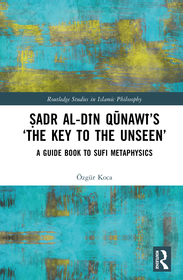
Ṣadr al-Dīn Qūnawī’s ‘The Key to the Unseen’
A Guide Book to Sufi Metaphysics
Sorozatcím: Routledge Studies in Islamic Philosophy;
-
10% KEDVEZMÉNY?
- Kiadói listaár GBP 155.00
-
74 051 Ft (70 525 Ft + 5% áfa)
Az ár azért becsült, mert a rendelés pillanatában nem lehet pontosan tudni, hogy a beérkezéskor milyen lesz a forint árfolyama az adott termék eredeti devizájához képest. Ha a forint romlana, kissé többet, ha javulna, kissé kevesebbet kell majd fizetnie.
- Kedvezmény(ek) 10% (cc. 7 405 Ft off)
- Kedvezményes ár 66 646 Ft (63 473 Ft + 5% áfa)
66 646 Ft

Beszerezhetőség
Még nem jelent meg, de rendelhető. A megjelenéstől számított néhány héten belül megérkezik.
Why don't you give exact delivery time?
A beszerzés időigényét az eddigi tapasztalatokra alapozva adjuk meg. Azért becsült, mert a terméket külföldről hozzuk be, így a kiadó kiszolgálásának pillanatnyi gyorsaságától is függ. A megadottnál gyorsabb és lassabb szállítás is elképzelhető, de mindent megteszünk, hogy Ön a lehető leghamarabb jusson hozzá a termékhez.
A termék adatai:
- Kiadás sorszáma 1
- Kiadó Routledge
- Megjelenés dátuma 2026. május 28.
- ISBN 9781041162124
- Kötéstípus Keménykötés
- Terjedelem198 oldal
- Méret 234x156 mm
- Nyelv angol 700
Kategóriák
Rövid leírás:
Ṣadr al-Dīn Qūnawī’s ‘The Key to the Unseen’: A Guide Book to Sufi Metaphysics offers the first systematic articulation of Ibn ʿArabī's teachings, presenting one of the most significant works of Islamic spirituality and a cornerstone of Sufi metaphysics through the synthesis of his foremost disciple, Ṣadr al-Dīn Qūnawī.
Több
Hosszú leírás:
Ṣadr al-Dīn Qūnawī’s ‘The Key to the Unseen’: A Guide Book to Sufi Metaphysics offers the first systematic articulation of Ibn ʿArabī’s revolutionary teachings, presenting one of the most significant works of Islamic spirituality and a cornerstone of Sufi metaphysics through the profound synthesis of his foremost disciple, Ṣadr al-Dīn Qūnawī.
Spanning the realms of mysticism, philosophy, and theology, this foundational text explores the intricate relationships between divine manifestation, cosmic hierarchy, and spiritual realization. From the systematic presentation of metaphysical principles to the practical dimensions of mystical experience, Qūnawī examines how rigorous intellectual inquiry can illuminate the deepest questions of existence while remaining rooted in lived spiritual transformation. Through his masterful synthesis, contributors to Islamic thought witness how Sufism evolved from purely experiential practice into formal scholarly discipline, establishing frameworks that would inspire generations of commentary and shape the trajectory of Islamic spirituality across diverse cultural contexts. The work also traces how mystical insight adapts to systematic articulation, illuminating the sophisticated negotiations between experiential knowledge, intellectual discourse, and spiritual authority. Despite its immense influence throughout the Muslim world, The Key to the Unseen has remained largely unknown in Western scholarship. This translation seeks to open its transformative vision to contemporary readers, serving both as an essential introduction to Qūnawī’s thought and as a vital window into one of the most fertile periods in Islamic philosophy and spirituality.
A foundational contribution to the study of Sufism, Islamic philosophy, and mystical traditions, this book is essential reading for scholars of Islamic studies, comparative religion, medieval philosophy, and spiritual literature.
"We are grateful to Özgür Koca for bringing one of Ṣadr al-Dīn's masterpieces, Miftāḥ Al-Ghayb to the attention of the English-speaking world. His translation is superb, and his commentary is immensely insightful and helpful. Ṣadr al-Dīn Qūnawī’s stands as a “meeting of the two oceans” in the history of Islamic spirituality: son-in-law to Shaykh al-Akbar, Ibn ‘Arabī, and close companion to Mawlānā Rūmī. It is through Qūnawī that the legacy of Ibn ‘Arabī is introduced to the East. Among other gifts, the Miftāḥ Al-Ghayb demonstrates how the Ibn ‘Arabī focus on wujūd (being, connected to ecstasy) becomes connected to love, leading us on a path to becoming a realized and completed human being (insān al-Kāmil). Here, it is God as the Real who is ultimately both the Lover and the Beloved. Highly recommended for all students of Sufism."
Omid Safi, Professor of Islamic Studies (Duke University); author of Radical Love: Teachings from the Islamic Mystical Tradition
"In translating al-Qūnawī’s Miftāh al-Ghayb, Özgür Koca has rendered an invaluable service. The detailed teachings of one of the most important metaphysical treatises of Islam are rendered with precision and care. The meticulous translation is complemented by an extensive commentary that plumbs the depths of the tradition to provide essential guidance for students of Islamic thought. This text should be required reading for anyone who wishes to understand Islamic metaphysical traditions.”
Joseph Lumbard, Hamad Bin Khalifa University, author of Aḥmad al-Ghazālī, Remembrance and the Metaphysics of Love
"Prof. Koca’s translation of Qūnawī’s extremely influential but difficult text is a welcome addition to the study of Islamic spirituality and metaphysics in the West—in particular the growing literature on the school of Ibn ‘Arabī. Despite Qūnawī’s reputation for being an expositor of the more “difficult” Ibn ‘Arabī, in fact Qūnawī’s writing is even more challenging in terms of its conciseness and its reliance upon and use of technical vocabulary related to the broader Islamic intellectual tradition. These terms must be rendered precisely in order for any sense to be made of the text at all. Koca’s excellent translation is explained by extensive commentary—absolutely essential for a work of this kind—which will be of enduring value both to scholars and to students."
Caner K. Dagli, Professor of Religious Studies, the College of the Holy Cross
TöbbTartalomjegyzék:
Introduction
The Life and Works of Ṣadr Al-Dīn Qūnawī
The Key to the Unseen (Miftāḥ Al-Ghayb)
The Influence of Qūnawī
Notes on the Translation and Commentary
1 On the Classification of Sciences and Metaphysics
2 On the Principles of Metaphysics
Section: [The Real as Being Itself]
Section: Knowing the Real
Section: The Divine Names
End of the General Introduction
3 On Union and Creation
Explanation of the General Secret and Clarification of the Core Subject
4 On the Cosmos and Order
A Precious Completion
5 On the Spiritual Path
Section: Love, Its Rulings and Secrets
Section: The Secret of Supplication, Its Rulings, and Fundamental Conditions
Section: On Veil
Supplement on This Topic
Knowledge Must Lead to Action
Additional Note
6 On Speech
Speech (Kalām), Its Rulings, Derivatives, and Related Matters
7 On the Perfect Human
A Comprehensive Completion Concerning All Sections
What is the Reality of the Human Being?
Where Did the Human Come from?
Where Did the Human Being Exist?
How Did the Human Being Come into Being?
Who Brought Him into Being?
Why Did He Come into Being?
What Is the Purpose of the Human's Coming into This World?
What Is the Purpose of the Human from the Perspective of the Primary and Essential Divine Will? What Is Intended from the Human in Terms of His Rank? What Is Intended from Him in Light of His Characteristics at Every Moment?
Has the Human Been Assisted in Some or All of the Goals Mentioned in Terms of Reality and Rank? Or Has Man Himself Sought Assistance in Terms of His Own Reality and Rank? Can Independence Be Claimed for God and Man, or Is Such Independence Absolutely Impossible, or Only Possible in Certain Circumstances and Impossible in Others?
What Exists in Man as Meaning, and What Exists Outside Him as Form? Or, What Exists in Him as Form and What Exists Outside Him as Meaning?
How Many Categories Are the Kinds of the Cosmos Limited to?
Reciprocity Between the Divine and the Created Realm
What Is the Priority of the Levels?
Second Knowledge on the Correspondence of Divine and Cosmic Archetypes
What Is the Essential Difference Between the Agent and the Acted-Upon Realities from the Perspective of Effects?
When the Absence of Witnessing Becomes a Cause that Increases the Zeal of the Seeker and Strengthens the Passion of the One Worthy of Perfection—and When It Does Not
Conclusion: Advice and Supplication
Több
