

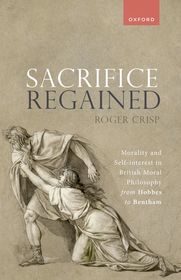
Sacrifice Regained
Morality and Self-Interest in British Moral Philosophy from Hobbes to Bentham
-
10% KEDVEZMÉNY?
- A kedvezmény csak az 'Értesítés a kedvenc témákról' hírlevelünk címzettjeinek rendeléseire érvényes.
- Kiadói listaár GBP 26.49
-
12 655 Ft (12 052 Ft + 5% áfa)
Az ár azért becsült, mert a rendelés pillanatában nem lehet pontosan tudni, hogy a beérkezéskor milyen lesz a forint árfolyama az adott termék eredeti devizájához képest. Ha a forint romlana, kissé többet, ha javulna, kissé kevesebbet kell majd fizetnie.
- Kedvezmény(ek) 10% (cc. 1 266 Ft off)
- Kedvezményes ár 11 389 Ft (10 847 Ft + 5% áfa)
Iratkozzon fel most és részesüljön kedvezőbb árainkból!
Feliratkozom
12 655 Ft

Beszerezhetőség
Becsült beszerzési idő: A Prosperónál jelenleg nincsen raktáron, de a kiadónál igen. Beszerzés kb. 3-5 hét..
A Prosperónál jelenleg nincsen raktáron.
Why don't you give exact delivery time?
A beszerzés időigényét az eddigi tapasztalatokra alapozva adjuk meg. Azért becsült, mert a terméket külföldről hozzuk be, így a kiadó kiszolgálásának pillanatnyi gyorsaságától is függ. A megadottnál gyorsabb és lassabb szállítás is elképzelhető, de mindent megteszünk, hogy Ön a lehető leghamarabb jusson hozzá a termékhez.
A termék adatai:
- Kiadó OUP Oxford
- Megjelenés dátuma 2023. október 18.
- ISBN 9780198896562
- Kötéstípus Puhakötés
- Terjedelem256 oldal
- Méret 233x153x13 mm
- Súly 376 g
- Nyelv angol 455
Kategóriák
Rövid leírás:
From Thomas Hobbes to Jeremy Bentham, 'British Moralists' have questioned whether being virtuous makes you happy. Roger Crisp elucidates their views on happiness and virtue, self-interest and sacrifice, and well-being and morality, and highlights key themes such as psychological egoism, evaluative hedonism, and moral reason in their thought.
TöbbHosszú leírás:
Does being virtuous make you happy? Roger Crisp examines the answers to this ancient question provided by the so-called 'British Moralists', from Thomas Hobbes, around 1650, for the next two hundred years, until Jeremy Bentham. This involves elucidating their views on happiness (self-interest, or well-being) and on virtue (or morality), in order to bring out the relation of each to the other. Themes ran through many of these writers: psychological egoism, evaluative hedonism, and—after Hobbes—the acceptance of self-standing moral reasons. But there are exceptions, and even those taking the standard views adopt them for very different reasons and express them in various ways. As the ancients tended to believe that virtue and happiness largely coincide, so these modern authors are inclined to accept posthumous reward and punishment. Both positions sit uneasily with the common-sense idea that a person can truly sacrifice their own good for the sake of morality or for others. This book shows that David Hume—a hedonist whose ethics made no appeal to the afterlife—was the first major British moralist to allow for, indeed to recommend, such self-sacrifice. Morality and well-being of course remain central to modern ethics, and Crisp demonstrates how much there is to learn from this remarkable group of philosophers.
Roger Crisp's excellent book concerns the relation between morality and self-interest in the British Moralists . . . Each chapter begins with a critical account of the moral theory of the moralist, followed by a critical discussion of the moralist's view of the relation between morality and self-interest. . . . Even readers not so concerned with the relation between morality and self-interest will benefit from the state-of-the-art treatments of the moral theories. You can piece together a fine short history of utilitarianism from the chapters on Cumberland, Hutcheson, Hume, Gay, Tucker, Paley and Bentham (and a short history of objections to utilitarianism from the chapters on Butler, Smith, and Price). And you can trace histories of certain strategies, such as (remarkably common) split-level defences of psychological egoism, rational egoism, or consequentialism.
Tartalomjegyzék:
Introduction: The Morality Question
Hobbes: The Return of Gyges
More: An Enthusiasm for Virtue
Cumberland: Divine Utilitarianism
Locke: The Sanctions of God
Mandeville: Morality After the Fall
Shaftesbury: Stoicism and the Art of Virtue
Butler: The Supremacy of Conscience
Hutcheson: Impartial Pleasures
Clarke: Virtue and the Life Hereafter
Reid: The Goodness of Virtue, and its Limits
Hume: Morality as Utility
Smith: The Delusions of Self-Love
Price: Morality as God
Gay, Tucker, Paley, and Bentham: Variations on the Theme of Happiness

