

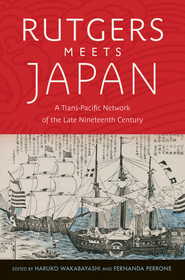
Rutgers Meets Japan
A Trans-Pacific Network of the Late Nineteenth Century
Sorozatcím: CERES: Rutgers Studies in History;
-
10% KEDVEZMÉNY?
- A kedvezmény csak az 'Értesítés a kedvenc témákról' hírlevelünk címzettjeinek rendeléseire érvényes.
- Kiadói listaár GBP 120.00
-
57 330 Ft (54 600 Ft + 5% áfa)
Az ár azért becsült, mert a rendelés pillanatában nem lehet pontosan tudni, hogy a beérkezéskor milyen lesz a forint árfolyama az adott termék eredeti devizájához képest. Ha a forint romlana, kissé többet, ha javulna, kissé kevesebbet kell majd fizetnie.
- Kedvezmény(ek) 10% (cc. 5 733 Ft off)
- Kedvezményes ár 51 597 Ft (49 140 Ft + 5% áfa)
Iratkozzon fel most és részesüljön kedvezőbb árainkból!
Feliratkozom
57 330 Ft

Beszerezhetőség
Még nem jelent meg, de rendelhető. A megjelenéstől számított néhány héten belül megérkezik.
Why don't you give exact delivery time?
A beszerzés időigényét az eddigi tapasztalatokra alapozva adjuk meg. Azért becsült, mert a terméket külföldről hozzuk be, így a kiadó kiszolgálásának pillanatnyi gyorsaságától is függ. A megadottnál gyorsabb és lassabb szállítás is elképzelhető, de mindent megteszünk, hogy Ön a lehető leghamarabb jusson hozzá a termékhez.
A termék adatai:
- Kiadó John Wiley & Sons
- Megjelenés dátuma 2026. április 29.
- Kötetek száma Hardback with laminated cover
- ISBN 9781978839113
- Kötéstípus Keménykötés
- Lásd még 9781978839106
- Terjedelem368 oldal
- Méret 235x156x30 mm
- Súly 490 g
- Nyelv angol
- Illusztrációk 8 color and 38 B-W images 700
Kategóriák
Hosszú leírás:
In 1867 Kusakabe Taro, a young samurai from Fukui, Japan, began studying at Rutgers as its first foreign student. Three years later, in 1870, his former tutor, friend, and Rutgers graduate, William Elliot Griffis, left for Japan to teach English and Science for three and a half years. The year 2020 marked the 150th anniversary of two landmark events in the history of the Rutgers-Japan relationship: the untimely death of Kusakabe only weeks before his graduation, and his friend Griffis’ departure to Japan.
Griffis and Kusakabe were only a small piece of a vast transnational network of leading modernizers of Japan in the 1860s and 70s. The Japanese students in New Brunswick were young and innovative men of samurai and aristocratic lineage, who were sent by reform-minded leaders of Japan, which was undergoing a dramatic transformation. They came to New Brunswick seeking Western knowledge that was much needed for the modernization of a newly forming nation. New Brunswick became the hub of a network of Japanese nationals that extended to the major cities of New York, Philadelphia, and Boston, and from there to the smaller towns of New England. Once in New Brunswick, these Japanese students were embraced by Protestant ministers, educators, and missionaries—both men and women—whose network encompassed Rutgers College and the neighboring New Brunswick Theological Seminary, and which stretched to Dutch Reformed parishes throughout the Eastern seaboard, and westward as far as the Dutch enclave of Holland, Michigan. Meanwhile, the American teachers and missionaries who left for Japan became part of a network of reformist leaders and Japanese returnees that extended to schools, colleges, and missions in Japan, and formed the foundations of Japan’s modern educational system. Through contributions from scholars and archivists in the U.S., Canada, and Japan, Rutgers Meets Japan aims to reconstruct the early Rutgers-Japan connections and examine the role and impact of this transnational network on Japan and the U.S. in the late nineteenth century.

