

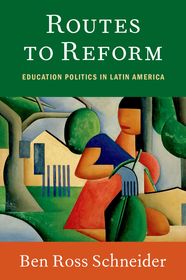
Routes to Reform
Education Politics in Latin America
-
10% KEDVEZMÉNY?
- A kedvezmény csak az 'Értesítés a kedvenc témákról' hírlevelünk címzettjeinek rendeléseire érvényes.
- Kiadói listaár GBP 19.99
-
9 025 Ft (8 595 Ft + 5% áfa)
Az ár azért becsült, mert a rendelés pillanatában nem lehet pontosan tudni, hogy a beérkezéskor milyen lesz a forint árfolyama az adott termék eredeti devizájához képest. Ha a forint romlana, kissé többet, ha javulna, kissé kevesebbet kell majd fizetnie.
- Kedvezmény(ek) 10% (kb. 903 Ft)
- Kedvezményes ár 8 122 Ft (7 736 Ft + 5% áfa)
Iratkozzon fel most és részesüljön kedvezőbb árainkból!
Feliratkozom
9 025 Ft

Beszerezhetőség
Becsült beszerzési idő: A Prosperónál jelenleg nincsen raktáron, de a kiadónál igen. Beszerzés kb. 3-5 hét..
A Prosperónál jelenleg nincsen raktáron.
Why don't you give exact delivery time?
A beszerzés időigényét az eddigi tapasztalatokra alapozva adjuk meg. Azért becsült, mert a terméket külföldről hozzuk be, így a kiadó kiszolgálásának pillanatnyi gyorsaságától is függ. A megadottnál gyorsabb és lassabb szállítás is elképzelhető, de mindent megteszünk, hogy Ön a lehető leghamarabb jusson hozzá a termékhez.
A termék adatai:
- Kiadó OUP USA
- Megjelenés dátuma 2024. augusztus 29.
- ISBN 9780197758861
- Kötéstípus Puhakötés
- Terjedelem216 oldal
- Méret 157x235x5 mm
- Súly 313 g
- Nyelv angol
- Illusztrációk 16 b/w line drawings; 6 tables 516
Kategóriák
Rövid leírás:
This is an open access title available under the terms of a CC BY-NC-ND 4.0 International licence. It is free to read on the Oxford Academic platform and offered as a free PDF download from OUP and selected open access locations.
In Routes to Reform, Ben Ross Schneider examines education policy throughout Latin America to show that reforms to improve learning--especially making teacher careers more meritocratic and less political--are possible. He contends that the first bottom-up route to reform is electoral. The second route was more top-down and technocratic, with little support from electorates or civil society. By framing education policy in a much broader comparative perspective, Schneider demonstrates that contrary to much established theory, reform outcomes in Latin America depended less on institutions and broad coalitions, but rather--due to the emptiness of the education policy space--on more micro factors like civil society organizations, teacher unions, policy networks, and technocrats.
Hosszú leírás:
This is an open access title available under the terms of a CC BY-NC-ND 4.0 International licence. It is free to read on the Oxford Academic platform and offered as a free PDF download from OUP and selected open access locations.
The key to sustained and equitable development in Latin America is high quality education for all. However, coalitions favoring quality reforms in education are usually weak because parents are dispersed, business is not interested, and much of the middle class has exited public education. In Routes to Reform, Ben Ross Schneider examines education policy throughout Latin America to show that reforms to improve learning--especially making teacher careers more meritocratic and less political--are possible. Several Andean countries and state governments in Brazil achieved notable reform since 2000, though on markedly different trajectories. Although rare, the first bottom-up route to reform was electoral. The second route was more top-down and technocratic, with little support from voters or civil society. Ultimately, by framing education policy in a much broader comparative perspective, Schneider demonstrates that contrary to much established theory, reform outcomes in Latin America depended less on institutions and broad coalitions, but rather--due to the emptiness of the education policy space--on more micro factors like civil society organizations, teacher unions, policy networks, and technocrats.
Anyone who studies education seriously understands that both the quantity and quality of public educational services provided by various societies and how societies allocate those services among social classes is heavily influenced by politics. In this valuable book, Ben Schneider helps us understand how politics has worked to promote educational reforms in Latin America
Tartalomjegyzék:
Preface
Part I: Theory and Arguments
1. Introduction: The Contentious Politics of Education
2. Theorizing on Education Politics: Macro to Micro
Part II: Reform Cases
3. Bottom-Up Reform in Chile: Electoral Mobilization, Policy Networks, and Civil Society
4. From Bottom-up to Top-down in Ecuador
5. Top Down Reform: Unions and Technocrats in Colombia and Peru
6.Union Blockage and Clientelist Backlash in Mexico, South Africa, Rio de Janeiro
Part III: Comparisons and Conclusions
7. Brazil: Innovating in the States
8. Parties, Coalitions, and Routes to Technical Education
9. Conclusions
Appendices (B-E online)
A. Interviews
B. Ministers of Education: Technocrats or Politicians
C. Governors and Parties in Brazil, 1999-2022
D. Protests and Demands in Education
E. Civil Society in Education
Bibliography
Index

