

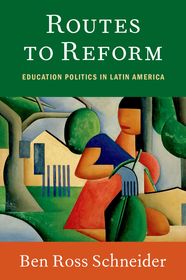
Routes to Reform
Education Politics in Latin America
- Publisher's listprice GBP 19.99
-
9 025 Ft (8 595 Ft + 5% VAT)
The price is estimated because at the time of ordering we do not know what conversion rates will apply to HUF / product currency when the book arrives. In case HUF is weaker, the price increases slightly, in case HUF is stronger, the price goes lower slightly.
- Discount 10% (cc. 903 Ft off)
- Discounted price 8 122 Ft (7 736 Ft + 5% VAT)
Subcribe now and take benefit of a favourable price.
Subscribe
9 025 Ft

Availability
Estimated delivery time: In stock at the publisher, but not at Prospero's office. Delivery time approx. 3-5 weeks.
Not in stock at Prospero.
Why don't you give exact delivery time?
Delivery time is estimated on our previous experiences. We give estimations only, because we order from outside Hungary, and the delivery time mainly depends on how quickly the publisher supplies the book. Faster or slower deliveries both happen, but we do our best to supply as quickly as possible.
Product details:
- Publisher OUP USA
- Date of Publication 29 August 2024
- ISBN 9780197758861
- Binding Paperback
- No. of pages216 pages
- Size 157x235x5 mm
- Weight 313 g
- Language English
- Illustrations 16 b/w line drawings; 6 tables 516
Categories
Short description:
This is an open access title available under the terms of a CC BY-NC-ND 4.0 International licence. It is free to read on the Oxford Academic platform and offered as a free PDF download from OUP and selected open access locations.
In Routes to Reform, Ben Ross Schneider examines education policy throughout Latin America to show that reforms to improve learning--especially making teacher careers more meritocratic and less political--are possible. He contends that the first bottom-up route to reform is electoral. The second route was more top-down and technocratic, with little support from electorates or civil society. By framing education policy in a much broader comparative perspective, Schneider demonstrates that contrary to much established theory, reform outcomes in Latin America depended less on institutions and broad coalitions, but rather--due to the emptiness of the education policy space--on more micro factors like civil society organizations, teacher unions, policy networks, and technocrats.
Long description:
This is an open access title available under the terms of a CC BY-NC-ND 4.0 International licence. It is free to read on the Oxford Academic platform and offered as a free PDF download from OUP and selected open access locations.
The key to sustained and equitable development in Latin America is high quality education for all. However, coalitions favoring quality reforms in education are usually weak because parents are dispersed, business is not interested, and much of the middle class has exited public education. In Routes to Reform, Ben Ross Schneider examines education policy throughout Latin America to show that reforms to improve learning--especially making teacher careers more meritocratic and less political--are possible. Several Andean countries and state governments in Brazil achieved notable reform since 2000, though on markedly different trajectories. Although rare, the first bottom-up route to reform was electoral. The second route was more top-down and technocratic, with little support from voters or civil society. Ultimately, by framing education policy in a much broader comparative perspective, Schneider demonstrates that contrary to much established theory, reform outcomes in Latin America depended less on institutions and broad coalitions, but rather--due to the emptiness of the education policy space--on more micro factors like civil society organizations, teacher unions, policy networks, and technocrats.
Anyone who studies education seriously understands that both the quantity and quality of public educational services provided by various societies and how societies allocate those services among social classes is heavily influenced by politics. In this valuable book, Ben Schneider helps us understand how politics has worked to promote educational reforms in Latin America
Table of Contents:
Preface
Part I: Theory and Arguments
1. Introduction: The Contentious Politics of Education
2. Theorizing on Education Politics: Macro to Micro
Part II: Reform Cases
3. Bottom-Up Reform in Chile: Electoral Mobilization, Policy Networks, and Civil Society
4. From Bottom-up to Top-down in Ecuador
5. Top Down Reform: Unions and Technocrats in Colombia and Peru
6.Union Blockage and Clientelist Backlash in Mexico, South Africa, Rio de Janeiro
Part III: Comparisons and Conclusions
7. Brazil: Innovating in the States
8. Parties, Coalitions, and Routes to Technical Education
9. Conclusions
Appendices (B-E online)
A. Interviews
B. Ministers of Education: Technocrats or Politicians
C. Governors and Parties in Brazil, 1999-2022
D. Protests and Demands in Education
E. Civil Society in Education
Bibliography
Index

