

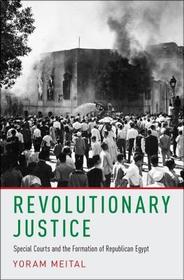
Revolutionary Justice
Special Courts and the Formation of Republican Egypt
-
10% KEDVEZMÉNY?
- A kedvezmény csak az 'Értesítés a kedvenc témákról' hírlevelünk címzettjeinek rendeléseire érvényes.
- Kiadói listaár GBP 97.00
-
43 795 Ft (41 710 Ft + 5% áfa)
Az ár azért becsült, mert a rendelés pillanatában nem lehet pontosan tudni, hogy a beérkezéskor milyen lesz a forint árfolyama az adott termék eredeti devizájához képest. Ha a forint romlana, kissé többet, ha javulna, kissé kevesebbet kell majd fizetnie.
- Kedvezmény(ek) 10% (kb. 4 379 Ft)
- Kedvezményes ár 39 416 Ft (37 539 Ft + 5% áfa)
Iratkozzon fel most és részesüljön kedvezőbb árainkból!
Feliratkozom
43 795 Ft

Beszerezhetőség
Megrendelésre a kiadó utánnyomja a könyvet. Rendelhető, de a szokásosnál kicsit lassabban érkezik meg.
Why don't you give exact delivery time?
A beszerzés időigényét az eddigi tapasztalatokra alapozva adjuk meg. Azért becsült, mert a terméket külföldről hozzuk be, így a kiadó kiszolgálásának pillanatnyi gyorsaságától is függ. A megadottnál gyorsabb és lassabb szállítás is elképzelhető, de mindent megteszünk, hogy Ön a lehető leghamarabb jusson hozzá a termékhez.
A termék adatai:
- Kiadó OUP USA
- Megjelenés dátuma 2016. december 8.
- ISBN 9780190600839
- Kötéstípus Keménykötés
- Terjedelem296 oldal
- Méret 165x236x27 mm
- Súly 664 g
- Nyelv angol 0
Kategóriák
Rövid leírás:
Revolutionary Justice narrates the power struggle between the Free Officers and their adversaries in the aftermath of Egypt's July Revolution of 1952 by studying trials held at the Revolution's Court and the People's Court. Meital shows that the rhetoric generated by Egypt's special courts played a crucial role in the denouement of political struggles, the creation of new historical narratives, and the shaping of both the regime and the opposition's public image.
TöbbHosszú leírás:
Revolutionary Justice narrates the power struggle between the Free Officers and their adversaries in the aftermath of Egypt's July Revolution of 1952 by studying trials held at the Revolution's Court and the People's Court. The establishment of these tribunals coincided with the most serious political crisis between the new regime and the opposition-primarily the Muslim Brothers and the Wafd party, but also senior officials in the previous government. By this point, the initial euphoria and the unbridled adoration for the Free Officers had worn off, and the focus of the public debate shifted to the legitimacy of the army's continued rule.
Yoram Meital charts the crucial events of Egyptian Revolution both within and outside the courtroom. The tribunals' transcripts, which constitute the prime source of his study, offer a rare glimpse of the dialogue between parties that held conflicting views. While "show trials" against political dissidents are generally considered of little historical value, Revolutionary Justice lucidly shows that the rhetoric generated by Egypt's special courts played a crucial role in the denouement of political struggles, the creation of new historical trends, and the shaping of both the regime and the opposition's public image. The deliberations at the courtroom reinforced the prevailing emergency atmosphere, helping the junta advance its plans for a new dispensation. On the other hand, the responses of defendants and witnesses during the trial exposed weaknesses in the official hegemonic narrative. Paradoxically, oppositional views that the regime tirelessly endeavored to silence were tolerated and recorded in the courtroom.
Yoram Meital's Revolutionary Justice: Special Courts and the Formation of Republican Egypt makes one of the most significant incursions into this field for a generation.
Tartalomjegyzék:
Acknowledgments
Abbreviations
Introduction
PART I - THE LEGAL DIMENSIONS OF A COUP
1. Extraordinary Tribunals in Modern Egypt: A Genealogy
2. Whitewashing a Coup
PART II - JUDGES AS HISTORIANS
3. The Revolution's Court
4. Who was Responsible for the 1948 Debacle?
5. Rhetoric and Historical Polemics
PART III - TURNING FRIENDS INTO FOES
6. The Advent of the People's Court
7. Officers-Brothers Relations: What Went Wrong?
8. The Trial of the Murshid
9. Trapped between Two Revolutions
Appendix I: Decree on the Crime of Treason - Law No. 344 of 1952
Appendix II: Decree on the Establishment of the Revolution's Court (1953)
Appendix III: Decree on the Establishment of the People's Court (1954)
Notes
Bibliography
Index

