

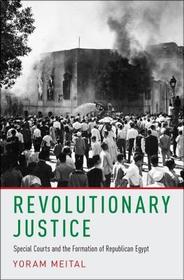
Revolutionary Justice
Special Courts and the Formation of Republican Egypt
- Publisher's listprice GBP 97.00
-
43 795 Ft (41 710 Ft + 5% VAT)
The price is estimated because at the time of ordering we do not know what conversion rates will apply to HUF / product currency when the book arrives. In case HUF is weaker, the price increases slightly, in case HUF is stronger, the price goes lower slightly.
- Discount 10% (cc. 4 379 Ft off)
- Discounted price 39 416 Ft (37 539 Ft + 5% VAT)
Subcribe now and take benefit of a favourable price.
Subscribe
43 795 Ft

Availability
printed on demand
Why don't you give exact delivery time?
Delivery time is estimated on our previous experiences. We give estimations only, because we order from outside Hungary, and the delivery time mainly depends on how quickly the publisher supplies the book. Faster or slower deliveries both happen, but we do our best to supply as quickly as possible.
Product details:
- Publisher OUP USA
- Date of Publication 8 December 2016
- ISBN 9780190600839
- Binding Hardback
- No. of pages296 pages
- Size 165x236x27 mm
- Weight 664 g
- Language English 0
Categories
Short description:
Revolutionary Justice narrates the power struggle between the Free Officers and their adversaries in the aftermath of Egypt's July Revolution of 1952 by studying trials held at the Revolution's Court and the People's Court. Meital shows that the rhetoric generated by Egypt's special courts played a crucial role in the denouement of political struggles, the creation of new historical narratives, and the shaping of both the regime and the opposition's public image.
MoreLong description:
Revolutionary Justice narrates the power struggle between the Free Officers and their adversaries in the aftermath of Egypt's July Revolution of 1952 by studying trials held at the Revolution's Court and the People's Court. The establishment of these tribunals coincided with the most serious political crisis between the new regime and the opposition-primarily the Muslim Brothers and the Wafd party, but also senior officials in the previous government. By this point, the initial euphoria and the unbridled adoration for the Free Officers had worn off, and the focus of the public debate shifted to the legitimacy of the army's continued rule.
Yoram Meital charts the crucial events of Egyptian Revolution both within and outside the courtroom. The tribunals' transcripts, which constitute the prime source of his study, offer a rare glimpse of the dialogue between parties that held conflicting views. While "show trials" against political dissidents are generally considered of little historical value, Revolutionary Justice lucidly shows that the rhetoric generated by Egypt's special courts played a crucial role in the denouement of political struggles, the creation of new historical trends, and the shaping of both the regime and the opposition's public image. The deliberations at the courtroom reinforced the prevailing emergency atmosphere, helping the junta advance its plans for a new dispensation. On the other hand, the responses of defendants and witnesses during the trial exposed weaknesses in the official hegemonic narrative. Paradoxically, oppositional views that the regime tirelessly endeavored to silence were tolerated and recorded in the courtroom.
Yoram Meital's Revolutionary Justice: Special Courts and the Formation of Republican Egypt makes one of the most significant incursions into this field for a generation.
Table of Contents:
Acknowledgments
Abbreviations
Introduction
PART I - THE LEGAL DIMENSIONS OF A COUP
1. Extraordinary Tribunals in Modern Egypt: A Genealogy
2. Whitewashing a Coup
PART II - JUDGES AS HISTORIANS
3. The Revolution's Court
4. Who was Responsible for the 1948 Debacle?
5. Rhetoric and Historical Polemics
PART III - TURNING FRIENDS INTO FOES
6. The Advent of the People's Court
7. Officers-Brothers Relations: What Went Wrong?
8. The Trial of the Murshid
9. Trapped between Two Revolutions
Appendix I: Decree on the Crime of Treason - Law No. 344 of 1952
Appendix II: Decree on the Establishment of the Revolution's Court (1953)
Appendix III: Decree on the Establishment of the People's Court (1954)
Notes
Bibliography
Index

