

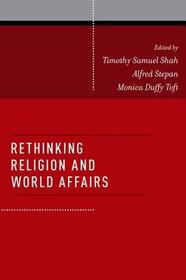
Rethinking Religion and World Affairs
-
10% KEDVEZMÉNY?
- A kedvezmény csak az 'Értesítés a kedvenc témákról' hírlevelünk címzettjeinek rendeléseire érvényes.
- Kiadói listaár GBP 39.99
-
18 055 Ft (17 195 Ft + 5% áfa)
Az ár azért becsült, mert a rendelés pillanatában nem lehet pontosan tudni, hogy a beérkezéskor milyen lesz a forint árfolyama az adott termék eredeti devizájához képest. Ha a forint romlana, kissé többet, ha javulna, kissé kevesebbet kell majd fizetnie.
- Kedvezmény(ek) 10% (kb. 1 806 Ft)
- Kedvezményes ár 16 249 Ft (15 476 Ft + 5% áfa)
Iratkozzon fel most és részesüljön kedvezőbb árainkból!
Feliratkozom
18 055 Ft

Beszerezhetőség
Megrendelésre a kiadó utánnyomja a könyvet. Rendelhető, de a szokásosnál kicsit lassabban érkezik meg.
Why don't you give exact delivery time?
A beszerzés időigényét az eddigi tapasztalatokra alapozva adjuk meg. Azért becsült, mert a terméket külföldről hozzuk be, így a kiadó kiszolgálásának pillanatnyi gyorsaságától is függ. A megadottnál gyorsabb és lassabb szállítás is elképzelhető, de mindent megteszünk, hogy Ön a lehető leghamarabb jusson hozzá a termékhez.
A termék adatai:
- Kiadó OUP USA
- Megjelenés dátuma 2012. március 22.
- ISBN 9780199827992
- Kötéstípus Puhakötés
- Terjedelem336 oldal
- Méret 165x239x27 mm
- Súly 522 g
- Nyelv angol 0
Kategóriák
Rövid leírás:
Drawing on the work of leading scholars as well as policy makers and analysts, this volume offers the most comprehensive and accessible exploration to date of the major puzzles, issues, and questions surrounding the complex and increasingly visible role of religion in world affairs.
TöbbHosszú leírás:
In recent years, the role of religion in the study and conduct of international affairs has become increasingly important. Rethinking Religion and World Affairs seeks to question and remedy the problematic neglect of religion in extant scholarship. Drawing on the work of leading scholars as well as policy makers and analysts, this volume will form the first comprehensive and authoritative guide to the interconnections of religion and global politics.
These essays grapple with puzzles, issues and questions concerning religion and world affairs in six major areas. Contributors critically revisit the "secularization thesis, " which proclaimed the steady erosion of religion's public presence as an effect of modernization; explore the relationship between religion, democracy, and the juridico-political discourse of human rights; assess the role of religion in fomenting, ameliorating, and redressing violent conflict; and consider the value of religious beliefs, actors, and institutions to the delivery of humanitarian aid and the fostering of socio-economic development. Later chapters address the representation of religion in the expanding global media landscape, the unique place of religion in American foreign policy, and the dilemmas it presents.
Rethinking Religion and World Affairs will become an invaluable resource for professional and emerging scholars, journalists, policy makers, diplomats, and others concerned in their personal or professional capacities with religion and international affairs.
There is an increasing recognition across the social sciences that the dominance of an epiphenomenal approach to the study of religion in world affairs has produced inadequate research and scholarship. This volume speaks creatively to that lack, exploring the key themes that arise when discussing religion in international affairs, focusing its six sections thematically on secularization, human rights, conflict and peace-making, civil society, media, and foreign policy.
Tartalomjegyzék:
Contributors
Editors' Introduction: Religion and World Affairs: Blurring the Boundaries - Timothy Samuel Shah, Alfred Stepan, and Monica Duffy Toft
Part 1: Religion, Secularism, and Secularization
1. Why Religion? Why Now? - J. Bryan Hehir
2. Rethinking Public Religions - José Casanova
3. The Politics of Secularism - Elizabeth Shakman Hurd
Part 2: Religion, Democracy, and Human Rights
4. Religion, Democracy, and the "Twin Tolerations ": Reconciling Political Freedom and Religious Autonomy - Alfred Stepan
5. How Should States Deal with Deep Religious Diversity: Can Anything Be Learnt from the Indian Model of Secularism? - Rajeev Bhargava
6. Rethinking Islam and Democracy - Robert W. Hefner
7. Religious Freedom, Democracy, and International Human Rights - John Witte, Jr. and M. Christian Green
Part 3: Religion, Conflict, and Peacemaking
8. Religion, Terrorism, and Civil Wars - Monica Duffy Toft
9. What Religion Contributes to the Politics of Transitional Justice - Daniel Philpott
Part 4: Religion, Humanitarianism, and Civil Society
10. Where Is the Religion? Humanitarianism, Faith, and World Affairs - Michael Barnett
11. Faith, Gender, and International Relations - Katherine Marshall
12. Religion and Development - Katherine Marshall
13. Interreligious Dialogue and International Relations - Thomas Banchoff
Part 5: Religion and the Media
14. Islam and the Promenades of Global Media - Mehrzad Boroujerdi and Nichole J. Allem
15. Old Monks, New Media, and the Limits of Soulcraft: A Case Study of Burma's 2007 Saffron Revolution - Diane Winston
Part 6: Religion and American Foreign Policy
16. God's Country? American Evangelicals and US Foreign Policy - Walter Russell Mead
17. America's International Religious Freedom Policy - Thomas F. Farr
18. Navigating in the Fog: Improving US Government Engagement with Religion - Frederick D. Barton, Shannon Hayden, and Karin von Hippel
Appendix: Internet Resource Guide - M. Christian Green with Nicole Greenfield
Index

