

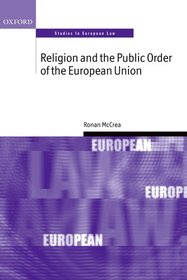
Religion and the Public Order of the European Union
Sorozatcím: Oxford Studies in European Law;
-
10% KEDVEZMÉNY?
- A kedvezmény csak az 'Értesítés a kedvenc témákról' hírlevelünk címzettjeinek rendeléseire érvényes.
- Kiadói listaár GBP 51.00
-
23 026 Ft (21 930 Ft + 5% áfa)
Az ár azért becsült, mert a rendelés pillanatában nem lehet pontosan tudni, hogy a beérkezéskor milyen lesz a forint árfolyama az adott termék eredeti devizájához képest. Ha a forint romlana, kissé többet, ha javulna, kissé kevesebbet kell majd fizetnie.
- Kedvezmény(ek) 10% (kb. 2 302 Ft)
- Kedvezményes ár 20 724 Ft (19 737 Ft + 5% áfa)
Iratkozzon fel most és részesüljön kedvezőbb árainkból!
Feliratkozom
23 026 Ft

Beszerezhetőség
Megrendelésre a kiadó utánnyomja a könyvet. Rendelhető, de a szokásosnál kicsit lassabban érkezik meg.
Why don't you give exact delivery time?
A beszerzés időigényét az eddigi tapasztalatokra alapozva adjuk meg. Azért becsült, mert a terméket külföldről hozzuk be, így a kiadó kiszolgálásának pillanatnyi gyorsaságától is függ. A megadottnál gyorsabb és lassabb szállítás is elképzelhető, de mindent megteszünk, hogy Ön a lehető leghamarabb jusson hozzá a termékhez.
A termék adatai:
- Kiadó OUP Oxford
- Megjelenés dátuma 2014. március 27.
- ISBN 9780198713944
- Kötéstípus Puhakötés
- Terjedelem332 oldal
- Méret 235x157x18 mm
- Súly 478 g
- Nyelv angol 0
Kategóriák
Rövid leírás:
The first account of the relationship between religion and the constitutional order of the EU, dealing with the key questions of religious freedom and the institutional role of religion and addressing the issues that are at the centre of public debate in Europe, such as the compatibility of Islam with European models of liberal democracy.
TöbbHosszú leírás:
Ronan McCrea offers the first comprehensive account of the role of religion within the public order of the European Union. He examines the facilitation and protection of individual and institutional religious freedom in EU law and the means through which the Union facilitates religious input and influence over law. Identifying the limitations on religious influence over law and politics that have been required by the Union, it demonstrates how such limitations have been identified as fundamental elements of the public order and prerequisites EU membership.
The Union seeks to balance its predominantly Christian religious heritage with an equally strong secular and humanist by facilitating religion as a form of cultural identity while simultaneously limiting its political influence. Such balancing takes place in the context of the Union's limited legitimacy and its commitment to respect for Member State cultural autonomy. Deference towards the cultural role of religion at Member State level enables culturally-entrenched religions to exercise a greater degree of influence within the Union's public order than "outsider" faiths that lack a comparable cultural role. Placing the Union's approach to religion in the context of broader historical and sociological trends around religion in Europe and of contemporary debates around secularism, equal treatment, and the role of Islam in Europe, McCrea sheds light on the interaction between religion and EU law in the face of a shifting religious demographic.
This is an outstanding work: remarkably broad in scope and capturing the many intricacies of EU law in its recognition and handling of religious belief and practice, yet also logically structured and lucid in its treatment of a complex subject matter. ... This is a thought-provoking analysis of a complex subject, revealing a mastery of detail and giving thorough consideration to the issues from a wide variety of angles.
Tartalomjegyzék:
Introduction
Europe's Religious Inheritance: Religion, Law and Identity in Contemporary Europe
Balance, Inheritance and Religion as a Basis of Law in the Public Order of the European Union
Religion as Identity and the Fundamental Rights Obligations of the Union
The Regulation of Religion in the Single Market
Competing Identities Limiting Religious Influence within the Public Order of the Union
Conclusion

