

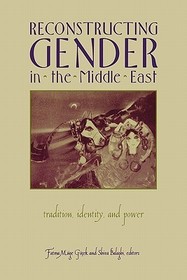
Reconstructing Gender in Middle East
Tradition, Identity, and Power
-
10% KEDVEZMÉNY?
- A kedvezmény csak az 'Értesítés a kedvenc témákról' hírlevelünk címzettjeinek rendeléseire érvényes.
- Kiadói listaár GBP 25.00
-
11 287 Ft (10 750 Ft + 5% áfa)
Az ár azért becsült, mert a rendelés pillanatában nem lehet pontosan tudni, hogy a beérkezéskor milyen lesz a forint árfolyama az adott termék eredeti devizájához képest. Ha a forint romlana, kissé többet, ha javulna, kissé kevesebbet kell majd fizetnie.
- Kedvezmény(ek) 10% (kb. 1 128 Ft)
- Kedvezményes ár 10 159 Ft (9 675 Ft + 5% áfa)
Iratkozzon fel most és részesüljön kedvezőbb árainkból!
Feliratkozom
11 287 Ft

Beszerezhetőség
Becsült beszerzési idő: A Prosperónál jelenleg nincsen raktáron, de a kiadónál igen. Beszerzés kb. 3-5 hét..
A Prosperónál jelenleg nincsen raktáron.
Why don't you give exact delivery time?
A beszerzés időigényét az eddigi tapasztalatokra alapozva adjuk meg. Azért becsült, mert a terméket külföldről hozzuk be, így a kiadó kiszolgálásának pillanatnyi gyorsaságától is függ. A megadottnál gyorsabb és lassabb szállítás is elképzelhető, de mindent megteszünk, hogy Ön a lehető leghamarabb jusson hozzá a termékhez.
A termék adatai:
- Kiadó Columbia University Press
- Megjelenés dátuma 1995. május 22.
- ISBN 9780231101233
- Kötéstípus Puhakötés
- Terjedelem246 oldal
- Nyelv angol 0
Kategóriák
Rövid leírás:
Employing a broad, interdisciplinary perspective on gender relations, Reconstructing Gender in the Middle East questions long-standing stereotypes about the traditional subordination of women in the region. With essays on gender construction in Iran, Turkey, Israel, Morocco, Egypt, Lebanon, and the Occupied Territories, this collection offers a wide-ranging exploration of tradition, identity, and power in different parts of the Middle East.
Seeking to overcome monolithic Western notions of women's life in "the traditional society," the essays in Part I reexamine the assumption that such societies leave little room for female participation.
Part II focuses on the reconstruction of identities by women in Iran, Turkey, Israel, and the Occupied Territories. The authors examine the complex variables that contribute to the development of identities -- including gender, class, and ethnicity -- in various Middle Eastern societies, questioning whether certain identities are more important to women than others. These essays also look at the issue of group identity formation versus the autonomy of the individual.
Part III looks at the relationship between gender and power in everyday life in Lebanon, Israel, Egypt, and Morocco, showing how power relations are constantly contested and renegotiated among family members and members of a community, between nations and between men and women.
WIth its collection of enlightened and diverse contemporary perspectives on women in the Middle East, Reconstructing Gender in the Middle East is an important work that will have significant impact on the way we look at gender in traditional societies.
TöbbHosszú leírás:
Employing a broad, interdisciplinary perspective on gender relations, Reconstructing Gender in the Middle East questions long-standing stereotypes about the traditional subordination of women in the region. With essays on gender construction in Iran, Turkey, Israel, Morocco, Egypt, Lebanon, and the Occupied Territories, this collection offers a wide-ranging exploration of tradition, identity, and power in different parts of the Middle East.
Seeking to overcome monolithic Western notions of women's life in "the traditional society," the essays in Part I reexamine the assumption that such societies leave little room for female participation.
Part II focuses on the reconstruction of identities by women in Iran, Turkey, Israel, and the Occupied Territories. The authors examine the complex variables that contribute to the development of identities -- including gender, class, and ethnicity -- in various Middle Eastern societies, questioning whether certain identities are more important to women than others. These essays also look at the issue of group identity formation versus the autonomy of the individual.
Part III looks at the relationship between gender and power in everyday life in Lebanon, Israel, Egypt, and Morocco, showing how power relations are constantly contested and renegotiated among family members and members of a community, between nations and between men and women.
WIth its collection of enlightened and diverse contemporary perspectives on women in the Middle East, Reconstructing Gender in the Middle East is an important work that will have significant impact on the way we look at gender in traditional societies.
Több
