

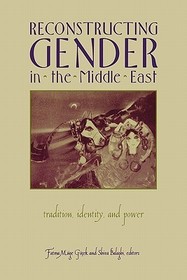
Reconstructing Gender in Middle East
Tradition, Identity, and Power
- Publisher's listprice GBP 25.00
-
11 287 Ft (10 750 Ft + 5% VAT)
The price is estimated because at the time of ordering we do not know what conversion rates will apply to HUF / product currency when the book arrives. In case HUF is weaker, the price increases slightly, in case HUF is stronger, the price goes lower slightly.
- Discount 10% (cc. 1 128 Ft off)
- Discounted price 10 159 Ft (9 675 Ft + 5% VAT)
Subcribe now and take benefit of a favourable price.
Subscribe
11 287 Ft

Availability
Estimated delivery time: In stock at the publisher, but not at Prospero's office. Delivery time approx. 3-5 weeks.
Not in stock at Prospero.
Why don't you give exact delivery time?
Delivery time is estimated on our previous experiences. We give estimations only, because we order from outside Hungary, and the delivery time mainly depends on how quickly the publisher supplies the book. Faster or slower deliveries both happen, but we do our best to supply as quickly as possible.
Product details:
- Publisher Columbia University Press
- Date of Publication 22 May 1995
- ISBN 9780231101233
- Binding Paperback
- No. of pages246 pages
- Language English 0
Categories
Short description:
Employing a broad, interdisciplinary perspective on gender relations, Reconstructing Gender in the Middle East questions long-standing stereotypes about the traditional subordination of women in the region. With essays on gender construction in Iran, Turkey, Israel, Morocco, Egypt, Lebanon, and the Occupied Territories, this collection offers a wide-ranging exploration of tradition, identity, and power in different parts of the Middle East.
Seeking to overcome monolithic Western notions of women's life in "the traditional society," the essays in Part I reexamine the assumption that such societies leave little room for female participation.
Part II focuses on the reconstruction of identities by women in Iran, Turkey, Israel, and the Occupied Territories. The authors examine the complex variables that contribute to the development of identities -- including gender, class, and ethnicity -- in various Middle Eastern societies, questioning whether certain identities are more important to women than others. These essays also look at the issue of group identity formation versus the autonomy of the individual.
Part III looks at the relationship between gender and power in everyday life in Lebanon, Israel, Egypt, and Morocco, showing how power relations are constantly contested and renegotiated among family members and members of a community, between nations and between men and women.
WIth its collection of enlightened and diverse contemporary perspectives on women in the Middle East, Reconstructing Gender in the Middle East is an important work that will have significant impact on the way we look at gender in traditional societies.
MoreLong description:
Employing a broad, interdisciplinary perspective on gender relations, Reconstructing Gender in the Middle East questions long-standing stereotypes about the traditional subordination of women in the region. With essays on gender construction in Iran, Turkey, Israel, Morocco, Egypt, Lebanon, and the Occupied Territories, this collection offers a wide-ranging exploration of tradition, identity, and power in different parts of the Middle East.
Seeking to overcome monolithic Western notions of women's life in "the traditional society," the essays in Part I reexamine the assumption that such societies leave little room for female participation.
Part II focuses on the reconstruction of identities by women in Iran, Turkey, Israel, and the Occupied Territories. The authors examine the complex variables that contribute to the development of identities -- including gender, class, and ethnicity -- in various Middle Eastern societies, questioning whether certain identities are more important to women than others. These essays also look at the issue of group identity formation versus the autonomy of the individual.
Part III looks at the relationship between gender and power in everyday life in Lebanon, Israel, Egypt, and Morocco, showing how power relations are constantly contested and renegotiated among family members and members of a community, between nations and between men and women.
WIth its collection of enlightened and diverse contemporary perspectives on women in the Middle East, Reconstructing Gender in the Middle East is an important work that will have significant impact on the way we look at gender in traditional societies.
More
