

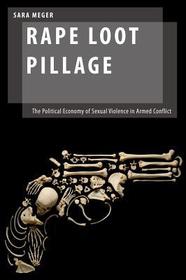
Rape Loot Pillage
The Political Economy of Sexual Violence in Armed Conflict
Sorozatcím: Oxford Studies in Gender and International Relations;
-
10% KEDVEZMÉNY?
- A kedvezmény csak az 'Értesítés a kedvenc témákról' hírlevelünk címzettjeinek rendeléseire érvényes.
- Kiadói listaár GBP 107.50
-
48 536 Ft (46 225 Ft + 5% áfa)
Az ár azért becsült, mert a rendelés pillanatában nem lehet pontosan tudni, hogy a beérkezéskor milyen lesz a forint árfolyama az adott termék eredeti devizájához képest. Ha a forint romlana, kissé többet, ha javulna, kissé kevesebbet kell majd fizetnie.
- Kedvezmény(ek) 10% (kb. 4 853 Ft)
- Kedvezményes ár 43 683 Ft (41 603 Ft + 5% áfa)
Iratkozzon fel most és részesüljön kedvezőbb árainkból!
Feliratkozom
48 536 Ft

Beszerezhetőség
Megrendelésre a kiadó utánnyomja a könyvet. Rendelhető, de a szokásosnál kicsit lassabban érkezik meg.
Why don't you give exact delivery time?
A beszerzés időigényét az eddigi tapasztalatokra alapozva adjuk meg. Azért becsült, mert a terméket külföldről hozzuk be, így a kiadó kiszolgálásának pillanatnyi gyorsaságától is függ. A megadottnál gyorsabb és lassabb szállítás is elképzelhető, de mindent megteszünk, hogy Ön a lehető leghamarabb jusson hozzá a termékhez.
A termék adatai:
- Kiadó OUP USA
- Megjelenés dátuma 2016. augusztus 18.
- ISBN 9780190277666
- Kötéstípus Keménykötés
- Terjedelem250 oldal
- Méret 236x163x27 mm
- Súly 612 g
- Nyelv angol 0
Kategóriák
Rövid leírás:
Rape Loot Pillage offers a new framework for understanding conflict-related sexual violence based on feminist international political economy. By looking at patterns of contemporary conflict this book proposes a new typology of wartime sexual violence that ties the 'value' of this violence to the politico-economic objectives of the perpetrators in different conflict contexts.
TöbbHosszú leírás:
What are the root causes of sexual violence in war? From times of antiquity through the most recent conflicts in Bosnia, Rwanda, the Congo, and Syria, rape and other forms of sexual violence have been a consistent feature of war. Analyses of these more recent conflicts have prompted a surge of research into rape as a weapon of war and prompted a number of international and national initiatives to address this form of violence. This work has helped to identify rape as a deliberate tool of war-making rather than simply an inevitable side effect of armed conflict. However, much of what has been written on rape as a weapon of war has suggested that the underlying causes stem from a single motivation--whether individual, symbolic, or strategic. This singular focus has led to disagreement in the field about how we can understand the causes and consequences of sexual violence in war and about how to respond to this atrocity. Sara Meger argues that it is this approach to sexual violence in war that has rendered ineffective recent attempts by the UN, national governments, and aid and advocacy organizations to address it. Rather than identifying conflict-related sexual violence as an isolated phenomenon, this book argues that sexual violence is a form of gender-based violence (perpetrated against both men and women) and a manifestation of unequal gender relations that are exacerbated by the social, political, and economic conditions of war. She looks at trends in the form and function of sexual violence in recent and ongoing conflicts to argue that, in different contexts, sexual violence takes different forms and is used in pursuit of different objectives. Taking a political economy perspective she argues that these variations can be explained by broader struggles over territory, assets, and other productive resources of contemporary armed conflicts. As it is a reflection of global political economic struggles, she argues that sexual violence in war can't be addressed only at the local level, but must be addressed through regional and international policy. She concludes by providing some initial ideas about how this can be done via the UN and national governments.
Thought-provoking contribution to scholarship
Tartalomjegyzék:
Acknowledgments
Introduction
Chapter 1: The Securitization of Sexual Violence
Chapter 2: Toward a Feminist Political Economy of Sexual Violence in War
Chapter 3: A Preliminary Typology of Wartime Sexual Violence
Chapter 4: Sexual Violence as an Instrument of Terror/Torture
Chapter 5: Sexual Violence as a Weapon of War
Chapter 6: Sexual Violence as an Element of Genocide
Chapter 7: The Political Economy of Sexual Violence in the DRC
Chapter 8: Sexual Violence against Men and Boys in Armed Conflict
Chapter 9: From Fetishization to Politicization and Gendered Peace
Appendix A: List of Interviewees
Notes
Bibliography
Index

