

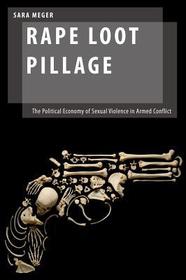
Rape Loot Pillage
The Political Economy of Sexual Violence in Armed Conflict
Series: Oxford Studies in Gender and International Relations;
- Publisher's listprice GBP 107.50
-
48 536 Ft (46 225 Ft + 5% VAT)
The price is estimated because at the time of ordering we do not know what conversion rates will apply to HUF / product currency when the book arrives. In case HUF is weaker, the price increases slightly, in case HUF is stronger, the price goes lower slightly.
- Discount 10% (cc. 4 853 Ft off)
- Discounted price 43 683 Ft (41 603 Ft + 5% VAT)
Subcribe now and take benefit of a favourable price.
Subscribe
48 536 Ft

Availability
printed on demand
Why don't you give exact delivery time?
Delivery time is estimated on our previous experiences. We give estimations only, because we order from outside Hungary, and the delivery time mainly depends on how quickly the publisher supplies the book. Faster or slower deliveries both happen, but we do our best to supply as quickly as possible.
Product details:
- Publisher OUP USA
- Date of Publication 18 August 2016
- ISBN 9780190277666
- Binding Hardback
- No. of pages250 pages
- Size 236x163x27 mm
- Weight 612 g
- Language English 0
Categories
Short description:
Rape Loot Pillage offers a new framework for understanding conflict-related sexual violence based on feminist international political economy. By looking at patterns of contemporary conflict this book proposes a new typology of wartime sexual violence that ties the 'value' of this violence to the politico-economic objectives of the perpetrators in different conflict contexts.
MoreLong description:
What are the root causes of sexual violence in war? From times of antiquity through the most recent conflicts in Bosnia, Rwanda, the Congo, and Syria, rape and other forms of sexual violence have been a consistent feature of war. Analyses of these more recent conflicts have prompted a surge of research into rape as a weapon of war and prompted a number of international and national initiatives to address this form of violence. This work has helped to identify rape as a deliberate tool of war-making rather than simply an inevitable side effect of armed conflict. However, much of what has been written on rape as a weapon of war has suggested that the underlying causes stem from a single motivation--whether individual, symbolic, or strategic. This singular focus has led to disagreement in the field about how we can understand the causes and consequences of sexual violence in war and about how to respond to this atrocity. Sara Meger argues that it is this approach to sexual violence in war that has rendered ineffective recent attempts by the UN, national governments, and aid and advocacy organizations to address it. Rather than identifying conflict-related sexual violence as an isolated phenomenon, this book argues that sexual violence is a form of gender-based violence (perpetrated against both men and women) and a manifestation of unequal gender relations that are exacerbated by the social, political, and economic conditions of war. She looks at trends in the form and function of sexual violence in recent and ongoing conflicts to argue that, in different contexts, sexual violence takes different forms and is used in pursuit of different objectives. Taking a political economy perspective she argues that these variations can be explained by broader struggles over territory, assets, and other productive resources of contemporary armed conflicts. As it is a reflection of global political economic struggles, she argues that sexual violence in war can't be addressed only at the local level, but must be addressed through regional and international policy. She concludes by providing some initial ideas about how this can be done via the UN and national governments.
Thought-provoking contribution to scholarship
Table of Contents:
Acknowledgments
Introduction
Chapter 1: The Securitization of Sexual Violence
Chapter 2: Toward a Feminist Political Economy of Sexual Violence in War
Chapter 3: A Preliminary Typology of Wartime Sexual Violence
Chapter 4: Sexual Violence as an Instrument of Terror/Torture
Chapter 5: Sexual Violence as a Weapon of War
Chapter 6: Sexual Violence as an Element of Genocide
Chapter 7: The Political Economy of Sexual Violence in the DRC
Chapter 8: Sexual Violence against Men and Boys in Armed Conflict
Chapter 9: From Fetishization to Politicization and Gendered Peace
Appendix A: List of Interviewees
Notes
Bibliography
Index

