

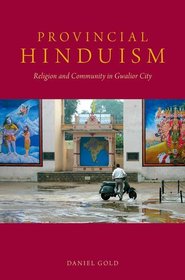
Provincial Hinduism
Religion and Community in Gwalior City
-
10% KEDVEZMÉNY?
- A kedvezmény csak az 'Értesítés a kedvenc témákról' hírlevelünk címzettjeinek rendeléseire érvényes.
- Kiadói listaár GBP 132.50
-
63 301 Ft (60 287 Ft + 5% áfa)
Az ár azért becsült, mert a rendelés pillanatában nem lehet pontosan tudni, hogy a beérkezéskor milyen lesz a forint árfolyama az adott termék eredeti devizájához képest. Ha a forint romlana, kissé többet, ha javulna, kissé kevesebbet kell majd fizetnie.
- Kedvezmény(ek) 10% (cc. 6 330 Ft off)
- Kedvezményes ár 56 971 Ft (54 258 Ft + 5% áfa)
Iratkozzon fel most és részesüljön kedvezőbb árainkból!
Feliratkozom
63 301 Ft

Beszerezhetőség
Megrendelésre a kiadó utánnyomja a könyvet. Rendelhető, de a szokásosnál kicsit lassabban érkezik meg.
Why don't you give exact delivery time?
A beszerzés időigényét az eddigi tapasztalatokra alapozva adjuk meg. Azért becsült, mert a terméket külföldről hozzuk be, így a kiadó kiszolgálásának pillanatnyi gyorsaságától is függ. A megadottnál gyorsabb és lassabb szállítás is elképzelhető, de mindent megteszünk, hogy Ön a lehető leghamarabb jusson hozzá a termékhez.
A termék adatai:
- Kiadó OUP USA
- Megjelenés dátuma 2015. március 5.
- ISBN 9780190212483
- Kötéstípus Keménykötés
- Terjedelem304 oldal
- Méret 157x239x22 mm
- Súly 630 g
- Nyelv angol
- Illusztrációk 53 b/w halftones 0
Kategóriák
Rövid leírás:
Provincial Hinduism explores intersecting religious domains of a medium-sized Indian city. Temples and Sufi shrines, the dynamics of caste and class, and specifically modern gurus and movements are described in a Hindu world that has experienced impacts of globalization but is still close to its traditional roots.
TöbbHosszú leírás:
Provincial Hinduism explores intersecting religious worlds in an ordinary Indian city that remains close to its traditional roots, while bearing witness to the impact of globalization. Daniel Gold looks at modern religious life in Gwalior, in the state of Mahdya Pradesh, drawing attention to the often complex religious sensibilities behind ordinary Hindu practice. Turning his attention to public places of worship, Gold describes temples of different types in the city, their legendary histories, and the people who patronize them. Issues of community and identity are discussed throughout the book, but particularly in the context of caste and class. Gold also explores concepts of community among Gwalior's Maharashtrians and Sindhis, groups with roots in other parts of the subcontinent that have settled in the city for generations. Functioning as internal diasporas, they organize in different ways and make distinctive contributions to local religious life. The book concludes by exploring characteristically modern religious institutions. Gold considers three religious service organizations inspired by the nineteenth-century reformer Swami Vivekenanda, as well as two groups that stem from the nineteenth-century Radhasoami tradition but have developed in different ways: the very large and populist North Indian movement around the late Baba Jaigurudev (d. 2012); and the devotees of Sant Kripal, a regional guru based in Gwalior who has a much smaller, middle-class following.
As the first book to analyze religious life in an ordinary, midsized Indian city, Provincial Hinduism will be an invaluable resource for scholars of contemporary Indian religion, culture, and society.
Lucid and accessible, this important book on religion in Gwalior makes a major contribution to the study of urban religion. Daniel Gold's long history of academic and personal engagement with religious people, shrines, and organizations in this city, with its historically important migrations and diverse religious identities, is, quite simply, stellar. Gold's lively style and careful definition of terms renders this work inviting to undergraduates as well as graduate and postgraduate scholars. It is sure to be helpful to and heralded by scholars of religion, anthropology, sociology, and history.
Tartalomjegyzék:
On Hearing the Transliteration
Introduction
Part I: A City in History with Temples and Shrines
1. Temples in the City
2. Sufi Shrines for Hindu Devotees
Part II: Community and Identity
3. Living Together in a Working-Class Neighborhood: Caste, Class, and Personal Affinities
4. Ethnic Communities and Regional Hinduisms: Maharashtrian and Sindhi
Part III: Institutions and Personalities
5. Hindu Ways of Organized Service: Legacies of Swami Vivekananda
6. Gurus, Disciples, and Ashrams: Beyond Radhasoami
Afterword: Personal Religious Identity in a Pluralist Society
Permissions
Acknowledgments
Notes

