

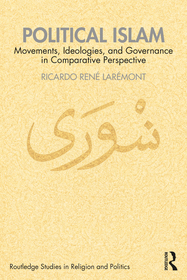
Political Islam
Movements, Ideologies, and Governance in Comparative Perspective
Sorozatcím: Routledge Studies in Religion and Politics;
-
10% KEDVEZMÉNY?
- Kiadói listaár GBP 43.99
-
19 861 Ft (18 915 Ft + 5% áfa)
Az ár azért becsült, mert a rendelés pillanatában nem lehet pontosan tudni, hogy a beérkezéskor milyen lesz a forint árfolyama az adott termék eredeti devizájához képest. Ha a forint romlana, kissé többet, ha javulna, kissé kevesebbet kell majd fizetnie.
- Kedvezmény(ek) 10% (kb. 1 986 Ft)
- Kedvezményes ár 17 875 Ft (17 024 Ft + 5% áfa)
17 875 Ft

Beszerezhetőség
Megrendelésre a kiadó utánnyomja a könyvet. Rendelhető, de a szokásosnál kicsit lassabban érkezik meg.
Why don't you give exact delivery time?
A beszerzés időigényét az eddigi tapasztalatokra alapozva adjuk meg. Azért becsült, mert a terméket külföldről hozzuk be, így a kiadó kiszolgálásának pillanatnyi gyorsaságától is függ. A megadottnál gyorsabb és lassabb szállítás is elképzelhető, de mindent megteszünk, hogy Ön a lehető leghamarabb jusson hozzá a termékhez.
A termék adatai:
- Kiadás sorszáma 1
- Kiadó Taylor & Francis
- Megjelenés dátuma 2026. január 23.
- ISBN 9781041166054
- Kötéstípus Puhakötés
- Terjedelem216 oldal
- Méret 234x156 mm
- Súly 450 g
- Nyelv angol
- Illusztrációk 2 Tables, black & white 758
Kategóriák
Rövid leírás:
Political Islam: Movements, Ideologies, and Governance in Comparative Perspective is a textbook that offers a comprehensive and accessible exploration of Islamist movements and the diverse political models they have pursued across the modern Muslim world.
TöbbHosszú leírás:
Political Islam: Movements, Ideologies, and Governance in Comparative Perspective is a textbook that offers a comprehensive and accessible exploration of Islamist movements and the diverse political models they have pursued across the modern Muslim world. Bridging theology, political theory, and case-based analysis, this book examines how religion, nationalism, and armed resistance have intersected to shape contemporary Muslim-majority states.
The book begins with foundational chapters that compare the historical relationship between religion and politics in Judaism, Christianity, and Islam and then outlines key differences between Western democratic theory and Islamic governance models. It proceeds to examine seminal Islamist movements, including the Muslim Brotherhood in Egypt, the ideological legacy of Sayyid Qutb, Iran?s Shi?i theocracy, and resistance movements such as Hezbollah, Hamas, and the Taliban. Each chapter integrates ideological analysis with political history, institutional development, and regional context. Unique among books in the field, Political Islam: Movements, Ideologies, and Governance in Comparative Perspective combines intellectual genealogy with detailed case studies and comparative frameworks, enabling students to grasp both the diversity and coherence of Islamist thought. The book also engages current events ? including the October 7, 2023, Hamas assault and its geopolitical aftermath ? while highlighting broader debates over Islamic law, militancy, democratization, and international humanitarian law.
This book will appeal to students and scholars of Middle East politics, Islamic studies, political theory, and global affairs, offering a nuanced and critical understanding of one of the most complex and consequential forces in modern world politics.
TöbbTartalomjegyzék:
Part I: Theoretical Foundations Chapter 1: The Varying Relationships between Religion and Politics in Judaism, Christianity, and Islam Chapter 2: Constructs of Western Democracy and Islamic Alternatives Part II: Case Studies in Political Islam Chapter 3: The Muslim Brotherhood in Egypt: Reform, Radicalism, and Political Retreat Chapter 4: Radicalism: Al Qaida and the Islamic State Chapter 5: The Islamic Republic of Iran: Velayat-e Faqih, Theocratic Statecraft, and the Geopolitics of Political Islam Chapter 6: Hezbollah: Shia Political Islam, Resistance, and Regional Militancy Chapter 7: Hamas: Islamism, Nationalism, and the Crisis of Palestinian Governance Chapter 8: The Taliban: Deobandi Islam, Pashtun Nationalism, and the Struggle for Islamic Governance Chapter 9:Continuities, Contradictions, and the Future of Political Islam
Több
