

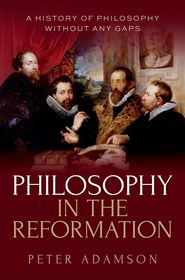
Philosophy in the Reformation
A history of philosophy without any gaps, Volume 8
Sorozatcím: A History of Philosophy;
-
10% KEDVEZMÉNY?
- A kedvezmény csak az 'Értesítés a kedvenc témákról' hírlevelünk címzettjeinek rendeléseire érvényes.
- Kiadói listaár GBP 25.00
-
11 287 Ft (10 750 Ft + 5% áfa)
Az ár azért becsült, mert a rendelés pillanatában nem lehet pontosan tudni, hogy a beérkezéskor milyen lesz a forint árfolyama az adott termék eredeti devizájához képest. Ha a forint romlana, kissé többet, ha javulna, kissé kevesebbet kell majd fizetnie.
- Kedvezmény(ek) 10% (cc. 1 129 Ft off)
- Kedvezményes ár 10 159 Ft (9 675 Ft + 5% áfa)
Iratkozzon fel most és részesüljön kedvezőbb árainkból!
Feliratkozom
11 287 Ft

Beszerezhetőség
Becsült beszerzési idő: A Prosperónál jelenleg nincsen raktáron, de a kiadónál igen. Beszerzés kb. 3-5 hét..
A Prosperónál jelenleg nincsen raktáron.
Why don't you give exact delivery time?
A beszerzés időigényét az eddigi tapasztalatokra alapozva adjuk meg. Azért becsült, mert a terméket külföldről hozzuk be, így a kiadó kiszolgálásának pillanatnyi gyorsaságától is függ. A megadottnál gyorsabb és lassabb szállítás is elképzelhető, de mindent megteszünk, hogy Ön a lehető leghamarabb jusson hozzá a termékhez.
A termék adatai:
- Kiadó OUP Oxford
- Megjelenés dátuma 2026. április 23.
- ISBN 9780198991236
- Kötéstípus Keménykötés
- Terjedelem704 oldal
- Méret 242x165x56 mm
- Súly 1018 g
- Nyelv angol 689
Kategóriák
Rövid leírás:
Peter Adamson presents an engaging and wide-ranging introduction to European philosophy in the fifteenth and sixteenth centuries, particularly the parallel and intertwining emergence of humanism and religious reform, as figures like Erasmus, Luther, and Calvin remade the intellectual and spiritual life of Europe.
TöbbHosszú leírás:
In this latest volume of A History of Philosophy Without Any Gaps, Peter Adamson presents a lively and accessible introduction to European philosophy during the fifteenth and sixteenth centuries.
Philosophy in the Reformation focuses on the parallel and intertwining emergence of humanism and of religious reform, as figures like Erasmus, Luther, and Calvin remade the intellectual and spiritual life of Europe. In the first three parts of the book, philosophical developments in central Europe, France, and Britain are examined. A wide range of topics and controversies are discussed, from debates over free will to the legitimacy of tyrannicide. This was also the time of the Northern Renaissance, which saw a resurgence of ancient concepts like skepticism and atomist theories of matter. The volume's final section charts the Catholic reaction to these epochal events in the Counter-Reformation, and especially the ideas of Spanish thinkers like Molina and Su??rez. Quite a few familiar figures are discussed, such as Montaigne and Copernicus. But as always in this series, Adamson lavishes attention on fascinating figures who are often ignored in the history of philosophy, like John Dee, Robert Fludd, and Oliva Sabuco (who is just one of numerous women intellectuals covered). Another feature of the book is its attention to literature and the arts: the reader will learn how the achievements of D??rer, Michelangelo, Shakespeare, and Cervantes relate to philosophical currents of the time. The eighth volume in the A History of Philosophy Without Any Gaps series takes us to the threshold of the early modern era and sets the stage for the developments that unfolded during the Enlightenment.
Tartalomjegyzék:
Preface
Acknowledgements
Dates
Map
Germany and the Low Countries
European Disunion: Introduction to the Reformation
Strong, Silent Type: The Printing Press
Lords of Language: Northern Humanism
Opposites Attract: Nicholas of Cusa
Books That Last Forever: Erasmus
One Way or Another: Northern Scholasticism
Faith, No More: Martin Luther
Take Your Choice: The Erasmus-Luther Debate
Depicting What Cannot Be Depicted: Two Renaissance Artworks
More Lutheran than Luther: Philip Melanchthon
No Lord but God: the Peasants' War and Radical Reformation
Slowly But Surely: Huldrych Zwingli
We Are Not Our Own: John Calvin
I Too Can Ask Questions: Protestant Scholasticism
Perhaps Not Wrong: Cornelius Agrippa
Just Add Salt: Paracelsus and Chemistry
The Acid Test: Theories of Matter
Born to Be Contrary: Toleration in the Netherlands
Everything is Mine, and Nothing: Lipsius and the Revival of Stoicism
The World Doesn't Revolve Around You: Copernicus
Best of Both Worlds: Tycho Brahe
Music of the Spheres: Johannes Kepler
France
Do As the Romans Did: Early French Humanism
Pearls of Wisdom: Marguerite of Navarre
Seriously Funny: Rabelais
Word Perfect: Logic and Language in Renaissance France
Life Is Not Enough: Medicine in Renaissance France
Make it Simple: Peter Ramus
Divide and Conquer: Ramism
Believe at Your Own Risk: Toleration in France
Constitutional Conventions: the Huguenots
One to Rule Them All: Jean Bodin
Pen Pals: Later French Humanism
Not Matter, But Me: Montaigne
What Do I Know? French Skepticism
The Tenth Muse: Marie Le Jars de Gournay
England and Scotland
God's is the Quarrel: The English Reformation
To Kill a King: The Scottish Reformation
Write Till Your Ink Be Dry: British Humanism
No Place Will Please Me So: Thomas More
With Such Perfection Govern: English Political Thought
The World's Law: Richard Hooker
Heaven-Bred Poesy: Philip Sidney and Edmund Spenser
Hast Any Philosophy In Thee? William Shakespeare
A Face Without a Heart: Shakespeare's Hamlet and Individualism
Brave New World: Shakespeare's Tempest and Colonialism
Weird Sisters: Shakespeare's Macbeth and Witchcraft
She Uttereth Piercing Eloquence: Women's Spiritual Literature
I'll Teach You Differences: British Scholasticism
If This Be Magic, Let It Be an Art: John Dee
Nature's Mystery: English Renaissance Science
The Eye Sees Not Itself But By Reflection: Theories of Vision
Metal More Attractive: William Gilbert and Magnetism
Unpathed Waters, Undreamed Shores: Robert Fludd
The Counter-Reformation
Don't Give Up Pope: Catholic Reformation
Cancel Culture: The Inquisition
Longitudinal Studies: Exploration and Science
Lambs to the Slaughter: Debating the New World
Marketplace of Letters: Iberian Humanism
The Dark Night Rises: Spanish Mysticism
Band of Brothers: the Jesuits
Not Doubting Thomas: the Aquinas Revival
Secondary Schools: Iberian Scholasticism
Could've, Would've, Should've: Free Will in the Second Scholastic
Better Than Nothing: Metaphysics in the Second Scholastic
The Price is Right: Law and Economics in the Second Scholastic
By Appointment Only: Political Philosophy in the Second Scholastic
Touch Me With Your Madness: Cervantes' Don Quixote
Take Your Medicine: Oliva Sabuco and Camilla Erculiani
Outsider Philosophy: The Cheese and the Worms
Cardinal Rule: Robert Bellarmine
Trial and Error: Galileo and the Inquisition
Further reading

