

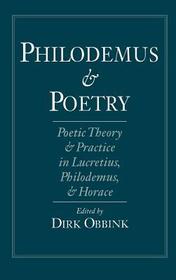
Philodemus and Poetry
Poetic Theory and Practice in Lucretius, Philodemus, and Horace
-
10% KEDVEZMÉNY?
- A kedvezmény csak az 'Értesítés a kedvenc témákról' hírlevelünk címzettjeinek rendeléseire érvényes.
- Kiadói listaár GBP 177.50
-
84 800 Ft (80 762 Ft + 5% áfa)
Az ár azért becsült, mert a rendelés pillanatában nem lehet pontosan tudni, hogy a beérkezéskor milyen lesz a forint árfolyama az adott termék eredeti devizájához képest. Ha a forint romlana, kissé többet, ha javulna, kissé kevesebbet kell majd fizetnie.
- Kedvezmény(ek) 10% (cc. 8 480 Ft off)
- Kedvezményes ár 76 320 Ft (72 686 Ft + 5% áfa)
Iratkozzon fel most és részesüljön kedvezőbb árainkból!
Feliratkozom
84 800 Ft

Beszerezhetőség
Megrendelésre a kiadó utánnyomja a könyvet. Rendelhető, de a szokásosnál kicsit lassabban érkezik meg.
Why don't you give exact delivery time?
A beszerzés időigényét az eddigi tapasztalatokra alapozva adjuk meg. Azért becsült, mert a terméket külföldről hozzuk be, így a kiadó kiszolgálásának pillanatnyi gyorsaságától is függ. A megadottnál gyorsabb és lassabb szállítás is elképzelhető, de mindent megteszünk, hogy Ön a lehető leghamarabb jusson hozzá a termékhez.
A termék adatai:
- Kiadó OUP USA
- Megjelenés dátuma 1995. augusztus 10.
- ISBN 9780195088151
- Kötéstípus Keménykötés
- Terjedelem336 oldal
- Méret 241x165x24 mm
- Súly 655 g
- Nyelv angol 0
Kategóriák
Rövid leírás:
Designed to offer a critical survey of trends and developments in recent scholarship on Philodemus of Gadara (c.110-40 BC) and Hellenistic literary theory, the essays in this volume treat the papyrus texts of Philodemus' treatises on poetry and the related subjects of rhetoric and music, establishing links with his Roman contemporaries Lucretius, Catullus, Horace, and Virgil. The volume contains a complete translation of Philodemus' On Poems Book 5. The essays evaluate Philodemus' formalism, which denied the moral utility of poetry as it sought to demonstrate the convergence of the Epicurean and the traditionally poetic. The distinguished contributors are D. Obbink, D. Clay, E. Asmis, D. Sider, M. Wigodsky, R. Janko, J. Porter, D. Blank, D. Armstrong, and S. Oberhelman.
TöbbHosszú leírás:
Building on recent advances in the reconstruction of the charred Papyri of Philodemus excavated from the Villa of the Papyri at Herculaneum, this volume presents eleven new chapters in the history of literary criticism in antiquity. Philodemus of Gadara (c.110-40 BC) shares with his Roman contemporaries Lucretius and Horace the fact that all excelled in the production of poetry, while all three were (at some stage in their careers) adherents of Epicureanism. Designed to offer a critical survey of trends and developments in recent scholarship on Philodemus in particular, and Hellenistic literary theory in general, the essays treat the newly published and re-edited papyrus texts of Philodemus' treatises on poetry and the related subjects of rhetoric and music. In addition, the volume contains a complete translation of a new text of Philodemus' On Poems book 5. The essays evaluate the philosophical and historical importance of these Epicurean treatises and of Philodemus as a literary theorist, and document connections between Greek philosophy and Roman literary production in the first century BC. The recent papyrus discoveries of Ennius, Lucretius, and Posidippus make this volume especially topical.
Philodemus was himself a poet of considerable repute. His Epigrams were noticed by Cicero and have been shown to have influenced the poetry of his younger contemporaries Catullus, Vergil, and Horace. As a literary critic, Philodemus embraced a formalism which denied both the moral utility of poems and the separability of content from poetic form. At the same time Philodemus, especially for the benefit of his wealthy patron Piso, sought to demonstrate the convergence of the Epicurean and the traditionally poetic, to show how Homer's poetry, for example, could be seen as providing moral and political paradigms and personal guidance for the potential ruler. How Philodemus attempted to reconcile this position with standard Epicurean views and his own rejection of the moral utility of poetry is a question explored by the essays in this volume.
An extremely useful discussion of the poetics of Philodemus of Gadara ... Highly recommended.

