

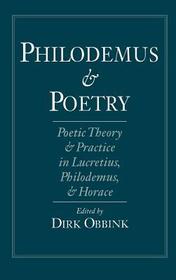
Philodemus and Poetry
Poetic Theory and Practice in Lucretius, Philodemus, and Horace
- Publisher's listprice GBP 177.50
-
84 800 Ft (80 762 Ft + 5% VAT)
The price is estimated because at the time of ordering we do not know what conversion rates will apply to HUF / product currency when the book arrives. In case HUF is weaker, the price increases slightly, in case HUF is stronger, the price goes lower slightly.
- Discount 10% (cc. 8 480 Ft off)
- Discounted price 76 320 Ft (72 686 Ft + 5% VAT)
Subcribe now and take benefit of a favourable price.
Subscribe
84 800 Ft

Availability
printed on demand
Why don't you give exact delivery time?
Delivery time is estimated on our previous experiences. We give estimations only, because we order from outside Hungary, and the delivery time mainly depends on how quickly the publisher supplies the book. Faster or slower deliveries both happen, but we do our best to supply as quickly as possible.
Product details:
- Publisher OUP USA
- Date of Publication 10 August 1995
- ISBN 9780195088151
- Binding Hardback
- No. of pages336 pages
- Size 241x165x24 mm
- Weight 655 g
- Language English 0
Categories
Short description:
Designed to offer a critical survey of trends and developments in recent scholarship on Philodemus of Gadara (c.110-40 BC) and Hellenistic literary theory, the essays in this volume treat the papyrus texts of Philodemus' treatises on poetry and the related subjects of rhetoric and music, establishing links with his Roman contemporaries Lucretius, Catullus, Horace, and Virgil. The volume contains a complete translation of Philodemus' On Poems Book 5. The essays evaluate Philodemus' formalism, which denied the moral utility of poetry as it sought to demonstrate the convergence of the Epicurean and the traditionally poetic. The distinguished contributors are D. Obbink, D. Clay, E. Asmis, D. Sider, M. Wigodsky, R. Janko, J. Porter, D. Blank, D. Armstrong, and S. Oberhelman.
MoreLong description:
Building on recent advances in the reconstruction of the charred Papyri of Philodemus excavated from the Villa of the Papyri at Herculaneum, this volume presents eleven new chapters in the history of literary criticism in antiquity. Philodemus of Gadara (c.110-40 BC) shares with his Roman contemporaries Lucretius and Horace the fact that all excelled in the production of poetry, while all three were (at some stage in their careers) adherents of Epicureanism. Designed to offer a critical survey of trends and developments in recent scholarship on Philodemus in particular, and Hellenistic literary theory in general, the essays treat the newly published and re-edited papyrus texts of Philodemus' treatises on poetry and the related subjects of rhetoric and music. In addition, the volume contains a complete translation of a new text of Philodemus' On Poems book 5. The essays evaluate the philosophical and historical importance of these Epicurean treatises and of Philodemus as a literary theorist, and document connections between Greek philosophy and Roman literary production in the first century BC. The recent papyrus discoveries of Ennius, Lucretius, and Posidippus make this volume especially topical.
Philodemus was himself a poet of considerable repute. His Epigrams were noticed by Cicero and have been shown to have influenced the poetry of his younger contemporaries Catullus, Vergil, and Horace. As a literary critic, Philodemus embraced a formalism which denied both the moral utility of poems and the separability of content from poetic form. At the same time Philodemus, especially for the benefit of his wealthy patron Piso, sought to demonstrate the convergence of the Epicurean and the traditionally poetic, to show how Homer's poetry, for example, could be seen as providing moral and political paradigms and personal guidance for the potential ruler. How Philodemus attempted to reconcile this position with standard Epicurean views and his own rejection of the moral utility of poetry is a question explored by the essays in this volume.
An extremely useful discussion of the poetics of Philodemus of Gadara ... Highly recommended.

