

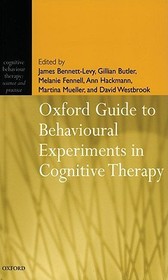
Oxford Guide to Behavioural Experiments in Cognitive Therapy
Sorozatcím: Cognitive Behaviour Therapy: Science and Practice;
-
10% KEDVEZMÉNY?
- A kedvezmény csak az 'Értesítés a kedvenc témákról' hírlevelünk címzettjeinek rendeléseire érvényes.
- Kiadói listaár GBP 62.00
-
27 993 Ft (26 660 Ft + 5% áfa)
Az ár azért becsült, mert a rendelés pillanatában nem lehet pontosan tudni, hogy a beérkezéskor milyen lesz a forint árfolyama az adott termék eredeti devizájához képest. Ha a forint romlana, kissé többet, ha javulna, kissé kevesebbet kell majd fizetnie.
- Kedvezmény(ek) 10% (kb. 2 799 Ft)
- Kedvezményes ár 25 194 Ft (23 994 Ft + 5% áfa)
Iratkozzon fel most és részesüljön kedvezőbb árainkból!
Feliratkozom
27 993 Ft

Beszerezhetőség
Becsült beszerzési idő: A Prosperónál jelenleg nincsen raktáron, de a kiadónál igen. Beszerzés kb. 3-5 hét..
A Prosperónál jelenleg nincsen raktáron.
Why don't you give exact delivery time?
A beszerzés időigényét az eddigi tapasztalatokra alapozva adjuk meg. Azért becsült, mert a terméket külföldről hozzuk be, így a kiadó kiszolgálásának pillanatnyi gyorsaságától is függ. A megadottnál gyorsabb és lassabb szállítás is elképzelhető, de mindent megteszünk, hogy Ön a lehető leghamarabb jusson hozzá a termékhez.
A termék adatai:
- Kiadó OUP Oxford
- Megjelenés dátuma 2004. május 6.
- ISBN 9780198529163
- Kötéstípus Puhakötés
- Terjedelem496 oldal
- Méret 234x156x26 mm
- Súly 739 g
- Nyelv angol
- Illusztrációk numerous tables and line drawings 0
Kategóriák
Rövid leírás:
Behavioural experiments are one of the central and most powerful methods of intervention in cognitive therapy. This is the first ever handbook of behavioural experiments. Containing examples of over 200 experiments, this book will be of enormous practical value for all those involved in cognitive behavioural therapy, as well as stimulating exploration in both its readers and their patients.
TöbbHosszú leírás:
Behavioural experiments are one of the central and most powerful methods of intervention in cognitive therapy. Yet until now, there has been no volume specifically dedicated to guiding physicians who wish to design and implement behavioural experiments across a wide range of clinical problems.
The Oxford Guide to Behavioural Experiments in Cognitive Therapy fills this gap. It is written by clinicians for clinicians. It is a practical, easy to read handbook, which is relevant for practising clinicians at every level, from trainees to cognitive therapy supervisors.
Following a foreword by David Clark, the first two chapters provide a theoretical and practical background for the understanding and development of behavioural experiments. Thereafter, the remaining chapters of the book focus on particular problem areas. These include problems which have been the traditional focus of cognitive therapy (e.g. depression, anxiety disorders), as well as those which have only more recently become a subject of study (bipolar disorder, psychotic symptoms), and some which are still in their relative infancy (physical health problems, brain injury). The book also includes several chapters on transdiagnostic problems, such as avoidance of affect, low self-esteem, interpersonal issues, and self-injurious behaviour. A final chapter by Christine Padesky provides some signposts for future development.
Containing examples of over 200 behavioural experiments, this book will be of enormous practical value for all those involved in cognitive behavioural therapy, as well as stimulating exploration and creativity in both its readers and their patients.
For anyone new coming into CBT, this book provides a wealth of learning and practical advice along with tried and trusted behavioural experiments for all the most common thinking distortions across all the major presenting problems common in everyday practice. Behavioural experiments are one of the mainstays and most powerful methods of intervention in cognitive therapy, so a book devoted to this one subject is well overdue and more than welcome.
Tartalomjegyzék:
Foreword
Behavioural experiments: historical and conceptual underpinnings
Devising effective behavioural experiments
Panic disorder and agoraphobia
Health anxiety
Obsessive-compulsive disorder
Generalised anxiety disorder
Social anxiety
Specific phobias
Post Traumatic Stress Disorder
Depression
Bipolar affective disorders
Psychotic symptoms
Eating disorders
Insomnia
Physical illness and disability
Acquired brain injury
Avoidance of affect
Self-injurious behaviour
Interpersonal difficulties
Low self-esteem
Behavioural experiments: at the crossroads

