

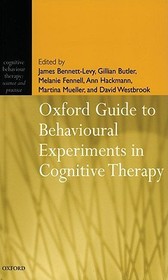
Oxford Guide to Behavioural Experiments in Cognitive Therapy
Series: Cognitive Behaviour Therapy: Science and Practice;
- Publisher's listprice GBP 62.00
-
27 993 Ft (26 660 Ft + 5% VAT)
The price is estimated because at the time of ordering we do not know what conversion rates will apply to HUF / product currency when the book arrives. In case HUF is weaker, the price increases slightly, in case HUF is stronger, the price goes lower slightly.
- Discount 10% (cc. 2 799 Ft off)
- Discounted price 25 194 Ft (23 994 Ft + 5% VAT)
Subcribe now and take benefit of a favourable price.
Subscribe
27 993 Ft

Availability
Estimated delivery time: In stock at the publisher, but not at Prospero's office. Delivery time approx. 3-5 weeks.
Not in stock at Prospero.
Why don't you give exact delivery time?
Delivery time is estimated on our previous experiences. We give estimations only, because we order from outside Hungary, and the delivery time mainly depends on how quickly the publisher supplies the book. Faster or slower deliveries both happen, but we do our best to supply as quickly as possible.
Product details:
- Publisher OUP Oxford
- Date of Publication 6 May 2004
- ISBN 9780198529163
- Binding Paperback
- No. of pages496 pages
- Size 234x156x26 mm
- Weight 739 g
- Language English
- Illustrations numerous tables and line drawings 0
Categories
Short description:
Behavioural experiments are one of the central and most powerful methods of intervention in cognitive therapy. This is the first ever handbook of behavioural experiments. Containing examples of over 200 experiments, this book will be of enormous practical value for all those involved in cognitive behavioural therapy, as well as stimulating exploration in both its readers and their patients.
MoreLong description:
Behavioural experiments are one of the central and most powerful methods of intervention in cognitive therapy. Yet until now, there has been no volume specifically dedicated to guiding physicians who wish to design and implement behavioural experiments across a wide range of clinical problems.
The Oxford Guide to Behavioural Experiments in Cognitive Therapy fills this gap. It is written by clinicians for clinicians. It is a practical, easy to read handbook, which is relevant for practising clinicians at every level, from trainees to cognitive therapy supervisors.
Following a foreword by David Clark, the first two chapters provide a theoretical and practical background for the understanding and development of behavioural experiments. Thereafter, the remaining chapters of the book focus on particular problem areas. These include problems which have been the traditional focus of cognitive therapy (e.g. depression, anxiety disorders), as well as those which have only more recently become a subject of study (bipolar disorder, psychotic symptoms), and some which are still in their relative infancy (physical health problems, brain injury). The book also includes several chapters on transdiagnostic problems, such as avoidance of affect, low self-esteem, interpersonal issues, and self-injurious behaviour. A final chapter by Christine Padesky provides some signposts for future development.
Containing examples of over 200 behavioural experiments, this book will be of enormous practical value for all those involved in cognitive behavioural therapy, as well as stimulating exploration and creativity in both its readers and their patients.
For anyone new coming into CBT, this book provides a wealth of learning and practical advice along with tried and trusted behavioural experiments for all the most common thinking distortions across all the major presenting problems common in everyday practice. Behavioural experiments are one of the mainstays and most powerful methods of intervention in cognitive therapy, so a book devoted to this one subject is well overdue and more than welcome.
Table of Contents:
Foreword
Behavioural experiments: historical and conceptual underpinnings
Devising effective behavioural experiments
Panic disorder and agoraphobia
Health anxiety
Obsessive-compulsive disorder
Generalised anxiety disorder
Social anxiety
Specific phobias
Post Traumatic Stress Disorder
Depression
Bipolar affective disorders
Psychotic symptoms
Eating disorders
Insomnia
Physical illness and disability
Acquired brain injury
Avoidance of affect
Self-injurious behaviour
Interpersonal difficulties
Low self-esteem
Behavioural experiments: at the crossroads

