

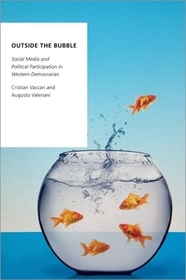
Outside the Bubble
Social Media and Political Participation in Western Democracies
Sorozatcím: Oxford Studies in Digital Politics;
-
10% KEDVEZMÉNY?
- A kedvezmény csak az 'Értesítés a kedvenc témákról' hírlevelünk címzettjeinek rendeléseire érvényes.
- Kiadói listaár GBP 24.99
-
11 282 Ft (10 745 Ft + 5% áfa)
Az ár azért becsült, mert a rendelés pillanatában nem lehet pontosan tudni, hogy a beérkezéskor milyen lesz a forint árfolyama az adott termék eredeti devizájához képest. Ha a forint romlana, kissé többet, ha javulna, kissé kevesebbet kell majd fizetnie.
- Kedvezmény(ek) 10% (cc. 1 128 Ft off)
- Kedvezményes ár 10 154 Ft (9 671 Ft + 5% áfa)
Iratkozzon fel most és részesüljön kedvezőbb árainkból!
Feliratkozom
11 282 Ft

Beszerezhetőség
Becsült beszerzési idő: A Prosperónál jelenleg nincsen raktáron, de a kiadónál igen. Beszerzés kb. 3-5 hét..
A Prosperónál jelenleg nincsen raktáron.
Why don't you give exact delivery time?
A beszerzés időigényét az eddigi tapasztalatokra alapozva adjuk meg. Azért becsült, mert a terméket külföldről hozzuk be, így a kiadó kiszolgálásának pillanatnyi gyorsaságától is függ. A megadottnál gyorsabb és lassabb szállítás is elképzelhető, de mindent megteszünk, hogy Ön a lehető leghamarabb jusson hozzá a termékhez.
A termék adatai:
- Kiadó OUP USA
- Megjelenés dátuma 2021. november 30.
- ISBN 9780190858483
- Kötéstípus Puhakötés
- Terjedelem304 oldal
- Méret 159x236x20 mm
- Súly 440 g
- Nyelv angol 158
Kategóriák
Rövid leírás:
Drawing on an original study of internet users across nine Western democracies, Outside the Bubble offers an unprecedented look at the effects of social media on democratic participation. The book reveals that, for most users, social media do not constitute echo chambers where people only hear what they want to hear. Instead, these platforms facilitate accidental encounters with news and exposure to electoral mobilization. While social media may contribute to many societal problems, they can help address at least two important democratic ills: citizens' apathy towards politics, and inequalities between those who choose to exercise their voice and those who remain silent.
TöbbHosszú leírás:
Much time has been spent over the past decade debating whether social media contribute to democracy. Drawing on an original study of internet users across nine Western democracies, Outside the Bubble offers an unprecedented look at the effects of social media on democratic participation.
This book argues that social media do indeed increase political participation in both online and face-to-face activities--and that they expand political equality across Western democracies. In fact, Cristian Vaccari and Augusto Valeriani find that, for the most part, social media do not constitute echo chambers or filter bubbles as most users see a mixture of political content they agree and disagree with. Various political experiences on social media have positive implications for participation and active political involvement: social media allow citizens to encounter clearly identifiable political viewpoints, facilitate accidental exposure to political news, and enable political actors and ordinary citizens to reach voters with electoral messages designed to mobilize them. Moreover, political interactions occurring on social media do not only benefit citizens who are already involved, but boost participation across the board. This is because social media offer both additional participatory incentives to the already engaged and new political opportunities for the less engaged.
By adopting a comparative approach, Vaccari and Valeriani also show that political institutions matter since some political experiences on social media are more strongly associated with participation in majoritarian systems and in party-centric systems. While social media may contribute to many societal problems, they can help address at least two important democratic ills: citizens' apathy towards politics, and inequalities between those who choose to exercise their voice and those who remain silent.
Combined with cataloging the fallacies that undergird most research about social media and political participation, this book illustrates the many ways people use social media and the still--manifesting implications of those uses.
Tartalomjegyzék:
Introduction
Chapter 1: Why Social Media Matter
Chapter 2: Political Participation in the Digital Age
Chapter 3: Of Arguments, Accidents, and Asks: How and Why Political Experiences Occur on Social Media
Chapter 4: Do Social Media Matter? Direct Effects of Agreement, Accidental Exposure, and Electoral Mobilization on Political Participation
Chapter 5: Picking Winners or Helping Losers? Social Media and Political Equality
Chapter 6: Does Context Matter? Political Experiences on Social Media in Comparative Perspective
Conclusions
References

