

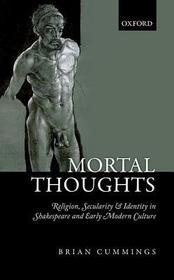
Mortal Thoughts
Religion, Secularity, & Identity in Shakespeare and Early Modern Culture
-
10% KEDVEZMÉNY?
- A kedvezmény csak az 'Értesítés a kedvenc témákról' hírlevelünk címzettjeinek rendeléseire érvényes.
- Kiadói listaár GBP 117.50
-
53 051 Ft (50 525 Ft + 5% áfa)
Az ár azért becsült, mert a rendelés pillanatában nem lehet pontosan tudni, hogy a beérkezéskor milyen lesz a forint árfolyama az adott termék eredeti devizájához képest. Ha a forint romlana, kissé többet, ha javulna, kissé kevesebbet kell majd fizetnie.
- Kedvezmény(ek) 10% (kb. 5 305 Ft)
- Kedvezményes ár 47 746 Ft (45 473 Ft + 5% áfa)
Iratkozzon fel most és részesüljön kedvezőbb árainkból!
Feliratkozom
53 051 Ft

Beszerezhetőség
Megrendelésre a kiadó utánnyomja a könyvet. Rendelhető, de a szokásosnál kicsit lassabban érkezik meg.
Why don't you give exact delivery time?
A beszerzés időigényét az eddigi tapasztalatokra alapozva adjuk meg. Azért becsült, mert a terméket külföldről hozzuk be, így a kiadó kiszolgálásának pillanatnyi gyorsaságától is függ. A megadottnál gyorsabb és lassabb szállítás is elképzelhető, de mindent megteszünk, hogy Ön a lehető leghamarabb jusson hozzá a termékhez.
A termék adatai:
- Kiadó OUP Oxford
- Megjelenés dátuma 2013. augusztus 22.
- ISBN 9780199677719
- Kötéstípus Keménykötés
- Terjedelem384 oldal
- Méret 223x154x30 mm
- Súly 584 g
- Nyelv angol
- Illusztrációk 25 black-and-white halftones 0
Kategóriák
Rövid leírás:
Mortal Thoughts is a study of the question of human identity in the early modern period. It examines literature alongside emerging forms of life writing and life drawing and self-portraits and considers portrayals of mortality and the moment of death.
TöbbHosszú leírás:
Since the nineteenth century, it has been assumed that the concept of personal identity in the early modern period is bound up with secularization. Indeed, many explanations of the emergence of modernity have been based on this thesis, in which Shakespeare as a secular author has played a central role. However, the idea of secularization is now everywhere under threat. The secularity of modern society is less apparent than it was a generation ago. Shakespeare, too, has come to be seen in a religious perspective. What happens to human identity in this different framework? Mortal Thoughts asks what selfhood looks like if we do not assume that an idea of the self could only come into being as a result of an emptying out of a religious framework. It does so by examining human mortality. What it is to be human, and how a life is framed by its ending, are issues that cross religious confessions in early modernity, and interrogate the sacred and secular divide. A series of chapters examines literature and art in relation to concepts such as conscience, martyrdom, soliloquy, luck, suicide, and embodiment. Religious and philosophical creativity are revealed as poised around anxieties about finitude and contingency, challenging conventional divisions between kinds of literary and artistic endeavour. Mortal Thoughts considers incipient genres of life writing (More, Foxe and Montaigne) and life drawing (Dürer, Hans Baldung Grien) in relation to dramatic representation and literary narration (Shakespeare, Donne, Milton). In the process it asks whether the problem of human identity rewrites historical boundaries.
a compelling bredth of reference, not merely to the early modern artists and writers who lend their names to the chapters...but to the entire range of classical authors on whom they drew.
Tartalomjegyzék:
Introduction: Secularization and Identity
The Mortal Self: Dürer and Montaigne
The Reformed Consicence: Thomas More
The Writer as Martyr: Cranmer and Foxe
Public Oathes and Private Selves: More, Foxe, and Shakespeare
Soliloquy and Secularisation: Shakespeare
Hamlet's Luck: Shakespeare and the Renaissance Bible
Freedom, Suicide, and Selfhood: Montaigne, Shakespeare, Donne
Soft Selves: Adam, Eve, and the Art of Embodiement
Bibliography

