

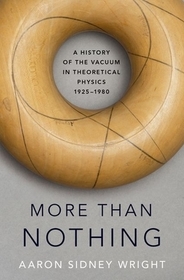
More than Nothing
A History of the Vacuum in Theoretical Physics, 1925-1980
-
10% KEDVEZMÉNY?
- A kedvezmény csak az 'Értesítés a kedvenc témákról' hírlevelünk címzettjeinek rendeléseire érvényes.
- Kiadói listaár GBP 82.00
-
37 023 Ft (35 260 Ft + 5% áfa)
Az ár azért becsült, mert a rendelés pillanatában nem lehet pontosan tudni, hogy a beérkezéskor milyen lesz a forint árfolyama az adott termék eredeti devizájához képest. Ha a forint romlana, kissé többet, ha javulna, kissé kevesebbet kell majd fizetnie.
- Kedvezmény(ek) 10% (kb. 3 702 Ft)
- Kedvezményes ár 33 321 Ft (31 734 Ft + 5% áfa)
Iratkozzon fel most és részesüljön kedvezőbb árainkból!
Feliratkozom
37 023 Ft

Beszerezhetőség
Becsült beszerzési idő: A Prosperónál jelenleg nincsen raktáron, de a kiadónál igen. Beszerzés kb. 3-5 hét..
A Prosperónál jelenleg nincsen raktáron.
Why don't you give exact delivery time?
A beszerzés időigényét az eddigi tapasztalatokra alapozva adjuk meg. Azért becsült, mert a terméket külföldről hozzuk be, így a kiadó kiszolgálásának pillanatnyi gyorsaságától is függ. A megadottnál gyorsabb és lassabb szállítás is elképzelhető, de mindent megteszünk, hogy Ön a lehető leghamarabb jusson hozzá a termékhez.
A termék adatai:
- Kiadó OUP USA
- Megjelenés dátuma 2024. június 19.
- ISBN 9780190062804
- Kötéstípus Keménykötés
- Terjedelem424 oldal
- Méret 147x226x35 mm
- Súly 726 g
- Nyelv angol 497
Kategóriák
Rövid leírás:
Across decades and disciplines, More than Nothing offers a scoping history of the vacuum as a lens into the development of modern physics.
TöbbHosszú leírás:
The vacuum is central to physicists' best theories of subatomic particles, gravitation, and cosmology. Nothingness provides the reference point with which to compare new particle creation and annihilation. Cosmologists use empty universes to study the causal structure of spacetime. Paradoxically, our best physical theories of particles, gravity, and spacetime are theories of nothingness. Stranger still, the physicists' vacuum is a hive of activity. Quantum fluctuations fill empty space with particles, and astronomers measure gravitational waves, the vibrations of empty spacetime itself.
More than Nothing uses the history of the vacuum to show how technical concepts in physics are made real through everyday practice. It provides new insight into the development of twentieth-century theoretical physics through sustained analysis of understudied figures including John Wheeler's geometrodynamics and Sidney Coleman's false vacuum. It reveals the surprising influence on physicists from the psychology of impossible objects to drawings of the black hole, and the ways in which the development of the physics of the vacuum became inseparable from the development of larger cultural movements in aesthetics, art, psychology, and fiction. Across decades and across disciplines, More than Nothing shows how physicists over and again chose to study the vacuum for insight into the world around them.
Drawing on newly unearthed laboratory notes, private letters, and published material, More than Nothing offers a scoping history of the vacuum as a lens into the development of modern physics.
In More than Nothing, Aaron Wright brings us to one of the great transformations of modern physics: the shift from seeing the void as pure absence to depicting the vacuum as a teeming structure of virtual particles and spacetime curvature. From the early twentieth to the early twenty-first century, physicists have developed practices, paper machinery, so to speak, to sort out why objects move, splinter, collide as they do: Feynman, Minkowski, Penrose diagrams, and other techniques fill the toolbox of abstract thought. Wright shows us how the story of the vacuum is one that captures what theoretical physicists have framed as the most fundamental entities in the universe
Tartalomjegyzék:
Chapter 1: The Vacuum in Practice
Chapter 2: Paul Dirac's Seas and Bubbles
Chapter 3: Nascent Pairs and Virtual Possibilities
Chapter 4: Weisskopf, Schwinger, Feynman: Vacuum Loops and Fluctuations
Chapter 5: John Archibald Wheeler: Everything from Nothing
Chapter 6: Roger Penrose's Impossible Diagrams
Chapter 7: Sidney Coleman's False Vacuum
Chapter 8: Epilogue
Chapter 9: The Void
Appendix A: Perturbations
Appendix B: Fluctuations
Bibliography

