

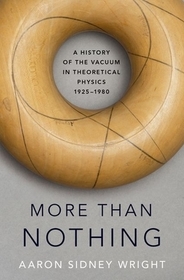
More than Nothing
A History of the Vacuum in Theoretical Physics, 1925-1980
- Publisher's listprice GBP 82.00
-
37 023 Ft (35 260 Ft + 5% VAT)
The price is estimated because at the time of ordering we do not know what conversion rates will apply to HUF / product currency when the book arrives. In case HUF is weaker, the price increases slightly, in case HUF is stronger, the price goes lower slightly.
- Discount 10% (cc. 3 702 Ft off)
- Discounted price 33 321 Ft (31 734 Ft + 5% VAT)
Subcribe now and take benefit of a favourable price.
Subscribe
37 023 Ft

Availability
Estimated delivery time: In stock at the publisher, but not at Prospero's office. Delivery time approx. 3-5 weeks.
Not in stock at Prospero.
Why don't you give exact delivery time?
Delivery time is estimated on our previous experiences. We give estimations only, because we order from outside Hungary, and the delivery time mainly depends on how quickly the publisher supplies the book. Faster or slower deliveries both happen, but we do our best to supply as quickly as possible.
Product details:
- Publisher OUP USA
- Date of Publication 19 June 2024
- ISBN 9780190062804
- Binding Hardback
- No. of pages424 pages
- Size 147x226x35 mm
- Weight 726 g
- Language English 497
Categories
Short description:
Across decades and disciplines, More than Nothing offers a scoping history of the vacuum as a lens into the development of modern physics.
MoreLong description:
The vacuum is central to physicists' best theories of subatomic particles, gravitation, and cosmology. Nothingness provides the reference point with which to compare new particle creation and annihilation. Cosmologists use empty universes to study the causal structure of spacetime. Paradoxically, our best physical theories of particles, gravity, and spacetime are theories of nothingness. Stranger still, the physicists' vacuum is a hive of activity. Quantum fluctuations fill empty space with particles, and astronomers measure gravitational waves, the vibrations of empty spacetime itself.
More than Nothing uses the history of the vacuum to show how technical concepts in physics are made real through everyday practice. It provides new insight into the development of twentieth-century theoretical physics through sustained analysis of understudied figures including John Wheeler's geometrodynamics and Sidney Coleman's false vacuum. It reveals the surprising influence on physicists from the psychology of impossible objects to drawings of the black hole, and the ways in which the development of the physics of the vacuum became inseparable from the development of larger cultural movements in aesthetics, art, psychology, and fiction. Across decades and across disciplines, More than Nothing shows how physicists over and again chose to study the vacuum for insight into the world around them.
Drawing on newly unearthed laboratory notes, private letters, and published material, More than Nothing offers a scoping history of the vacuum as a lens into the development of modern physics.
In More than Nothing, Aaron Wright brings us to one of the great transformations of modern physics: the shift from seeing the void as pure absence to depicting the vacuum as a teeming structure of virtual particles and spacetime curvature. From the early twentieth to the early twenty-first century, physicists have developed practices, paper machinery, so to speak, to sort out why objects move, splinter, collide as they do: Feynman, Minkowski, Penrose diagrams, and other techniques fill the toolbox of abstract thought. Wright shows us how the story of the vacuum is one that captures what theoretical physicists have framed as the most fundamental entities in the universe
Table of Contents:
Chapter 1: The Vacuum in Practice
Chapter 2: Paul Dirac's Seas and Bubbles
Chapter 3: Nascent Pairs and Virtual Possibilities
Chapter 4: Weisskopf, Schwinger, Feynman: Vacuum Loops and Fluctuations
Chapter 5: John Archibald Wheeler: Everything from Nothing
Chapter 6: Roger Penrose's Impossible Diagrams
Chapter 7: Sidney Coleman's False Vacuum
Chapter 8: Epilogue
Chapter 9: The Void
Appendix A: Perturbations
Appendix B: Fluctuations
Bibliography

