

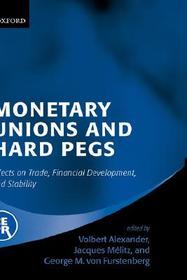
Monetary Unions and Hard Pegs
Effects on Trade, Financial Development, and Stability
-
10% KEDVEZMÉNY?
- A kedvezmény csak az 'Értesítés a kedvenc témákról' hírlevelünk címzettjeinek rendeléseire érvényes.
- Kiadói listaár GBP 67.00
-
32 009 Ft (30 485 Ft + 5% áfa)
Az ár azért becsült, mert a rendelés pillanatában nem lehet pontosan tudni, hogy a beérkezéskor milyen lesz a forint árfolyama az adott termék eredeti devizájához képest. Ha a forint romlana, kissé többet, ha javulna, kissé kevesebbet kell majd fizetnie.
- Kedvezmény(ek) 10% (cc. 3 201 Ft off)
- Kedvezményes ár 28 808 Ft (27 437 Ft + 5% áfa)
Iratkozzon fel most és részesüljön kedvezőbb árainkból!
Feliratkozom
32 009 Ft

Beszerezhetőség
Megrendelésre a kiadó utánnyomja a könyvet. Rendelhető, de a szokásosnál kicsit lassabban érkezik meg.
Why don't you give exact delivery time?
A beszerzés időigényét az eddigi tapasztalatokra alapozva adjuk meg. Azért becsült, mert a terméket külföldről hozzuk be, így a kiadó kiszolgálásának pillanatnyi gyorsaságától is függ. A megadottnál gyorsabb és lassabb szállítás is elképzelhető, de mindent megteszünk, hogy Ön a lehető leghamarabb jusson hozzá a termékhez.
A termék adatai:
- Kiadó OUP Oxford
- Megjelenés dátuma 2004. március 25.
- ISBN 9780199271405
- Kötéstípus Keménykötés
- Terjedelem400 oldal
- Méret 241x163x27 mm
- Súly 744 g
- Nyelv angol
- Illusztrációk numerous tables & figures 0
Kategóriák
Rövid leírás:
Financial services with global reach are becoming ever more important in the conduct and organization of the trade and investment of nations. Currencies that lack international standing lose out in this business. The result of financial development has been destabilizing currency and portfolio substitution in favour of international and against local currencies. Concrete investigations of alternative approaches to overcoming this monetary division formally in this volume range from hard pegs, such as Argentina's currency board, to formal dollarization, as in Ecuador, and monetary union, as in Europe. Basing their arguments on the beneficial effects on trade among monetary-union members and their financial development and stability, these studies suggest that monetary union deserves a much more sympathetic hearing than normally accorded by national and international decisionmakers.
TöbbHosszú leírás:
Financial services with global reach are becoming ever more important in the conduct and organization of the trade and investment of nations, and currencies that lack international standing lose out in this business. The result of financial development has been destabilizing currency and portfolio substitution -- in favour of international currencies and against local ones.
This book analyses formal approaches to overcoming monetary divisions within countries and within integrating regions, focusing on the consequences of monetary union for trade among union members and their financial development and stability. The authors discuss hard pegs such as those attempted by the currency board of Argentina, outright dollarization, such as in Ecuador, and multilateral monetary union, as in Europe, the least reversible form of monetary union and the most powerful elixir of financial integration and trade.
The political classes and central banks in most countries have been reluctant to admit the market- and technology-driven forces of currency consolidation, much less yield to them. International financial institutions too are still in the habit of proffering advice about national monetary and exchange-rate policies on the assumption that getting rid of both is not even an option. Emerging-market countries, in particular, have to choose between retaining what independent monetary means they still have -- and can safely use in the presence of widespread liability dollarization and currency mismatches -- and formally replacing the domestic with an international currency to reduce exposure to debilitating financial crises. In concrete investigations of this choice, this volume shows that monetary union deserves a much more sympathetic hearing.
Tartalomjegyzék:
Preface
Editorial Introduction
Part I: Current and Past Concepts of Monetary Union
Euroization, Dollarization and the International Monetary System
Unilateral and Multilateral Currency Unions: Thoughts from an EMU Perspective
International Money and Common Currencies in Historical Perspective
Part II: Trade and Price Effects of Monetary Union
Geography, Trade and Currency Union
Comparing Apples and Oranges: The Effect of Multilateral Currency Unions on Trade
The Effect of Common Currencies on International Trade: a Meta-Analysis
Common Currencies and Market Integration Across Cities: How Strong is the Link?Common Currencies and Market Integration Across Cities: How Strong is the Link?
Part III: Monetary Integration In Latin America
Trade Agreements, Exchange Rate Disagreements
Sudden Stops, the Real Exchange Rate and Fiscal Sustainability: Argentina's Lessons
Living and Dying with Hard Pegs: The Rise and Fall of Argentina's Currency Board
Anatomy of a Multiple Crisis: Why Was Argentina Special and What Have We Learned from It?
Part IV: Common Monies, Political Interests, and Infrastructure
America's Interest in Dollarization
Dollarization and Euroization in Transition Countries: Currency Substitution, Asset Substitution, Network Externalities and Irreversibility
Electronic Money and The Optimal Size Of Monetary Unions
Currency Substitution in Anticipation of EU Accession
Allocating Lending of Last Resort and Supervision in the Euro Area
Index

