

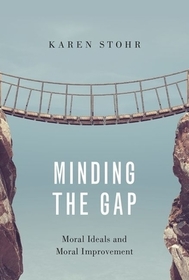
Minding the Gap
Moral Ideals and Moral Improvement
-
10% KEDVEZMÉNY?
- A kedvezmény csak az 'Értesítés a kedvenc témákról' hírlevelünk címzettjeinek rendeléseire érvényes.
- Kiadói listaár GBP 79.00
-
35 668 Ft (33 970 Ft + 5% áfa)
Az ár azért becsült, mert a rendelés pillanatában nem lehet pontosan tudni, hogy a beérkezéskor milyen lesz a forint árfolyama az adott termék eredeti devizájához képest. Ha a forint romlana, kissé többet, ha javulna, kissé kevesebbet kell majd fizetnie.
- Kedvezmény(ek) 10% (cc. 3 567 Ft off)
- Kedvezményes ár 32 102 Ft (30 573 Ft + 5% áfa)
Iratkozzon fel most és részesüljön kedvezőbb árainkból!
Feliratkozom
35 668 Ft

Beszerezhetőség
Csak rendelésre kapható a kiadónál, kissé időigényes.
Why don't you give exact delivery time?
A beszerzés időigényét az eddigi tapasztalatokra alapozva adjuk meg. Azért becsült, mert a terméket külföldről hozzuk be, így a kiadó kiszolgálásának pillanatnyi gyorsaságától is függ. A megadottnál gyorsabb és lassabb szállítás is elképzelhető, de mindent megteszünk, hogy Ön a lehető leghamarabb jusson hozzá a termékhez.
A termék adatai:
- Kiadó OUP USA
- Megjelenés dátuma 2019. október 10.
- ISBN 9780190867522
- Kötéstípus Keménykötés
- Terjedelem276 oldal
- Méret 147x216x25 mm
- Súly 454 g
- Nyelv angol 0
Kategóriák
Rövid leírás:
The book is an exploration of how we narrow the gap between our moral ideals and our actual selves. It develops an account of moral improvement as a practical project requiring what Karen Stohr calls a "moral neighborhood." Moral neighborhoods are constructed through social practices that instantiate shared moral ideals in a flawed world.
TöbbHosszú leírás:
Most of us care about being a good person. Most of us also recognize that we fall far short of our morals aspirations, that there is a gap between what we are like and what we think we should be like. The aim of moral improvement is to narrow that gap. And yet as a practical undertaking, moral improvement is beset by difficulties. We are not very good judges of what we are like and we are often unclear about what it would mean to be better. This book aims to give an honest account of moral improvement that takes seriously the challenges that we encounter--the practical and philosophical--in trying to make ourselves morally better.
Ethical theories routinely present us with accounts of ideal moral agents that we are supposed to emulate. These accounts, however, often lack normative authority for us and they may also fail to provide us with adequate guidance about how to live in our flawed moral reality. Stohr presents moral improvement as a project for non-ideal persons living in non-ideal circumstances. An adequate account of moral improvement must have psychologically plausible starting points and rely on ideals that are normatively authoritative and regulatively efficacious for the person trying to emulate them. Moral improvement should be understood as the project of articulating and inhabiting an aspirational moral identity. That identity is cultivated through existing practical identities and standpoints, which are fundamentally social and which generate practical conflicts about how to live. The success of moral improvement depends on it taking place within what she calls good "moral neighborhoods." Moral neighborhoods are collaborative normative spaces, constructed from networks of social practices and conventions, in which we can articulate and act as better versions of ourselves. The book concludes with a discussion of three social practices that contribute to good moral neighborhoods, and so to moral improvement.
In this innovative book, Karen Stohr breaks new ground in understanding how we develop our moral ideals and set about the task of moral improvement. Her fascinating account includes explorations of the obstacles to moral improvement, moral identity, the development of aspirational ideals, the social aspects of moral improvement through the construction of moral neighborhoods, and the related notions of moral stagecraft and moral pretense. In formulating her ideas, she draws on Aristotle, Kant,Confucianism, Jane Austen, and Erving Goffman, among other sources ... Stohr'sbook is a major contribution to philosophical thinking about moral formation.
Tartalomjegyzék:
Introduction
Chapter 1: The Gap
Chapter 2: Where We Stand
Chapter 3: Moral Identities
Chapter 4: Moral Aspirations
Chapter 5: Moral Neighborhoods
Chapter 6: Moral Stagecraft
Chapter 7: Social Pretense
Chapter 8: Self-Deprecation
Chapter 9: Being Agreeable
Chapter 10: The Veil of Philanthropy
Conclusion
Bibliography

