

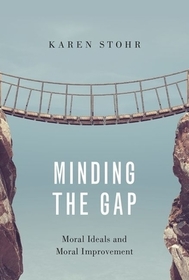
Minding the Gap
Moral Ideals and Moral Improvement
- Publisher's listprice GBP 79.00
-
35 668 Ft (33 970 Ft + 5% VAT)
The price is estimated because at the time of ordering we do not know what conversion rates will apply to HUF / product currency when the book arrives. In case HUF is weaker, the price increases slightly, in case HUF is stronger, the price goes lower slightly.
- Discount 10% (cc. 3 567 Ft off)
- Discounted price 32 102 Ft (30 573 Ft + 5% VAT)
Subcribe now and take benefit of a favourable price.
Subscribe
35 668 Ft

Availability
Only to order.
Why don't you give exact delivery time?
Delivery time is estimated on our previous experiences. We give estimations only, because we order from outside Hungary, and the delivery time mainly depends on how quickly the publisher supplies the book. Faster or slower deliveries both happen, but we do our best to supply as quickly as possible.
Product details:
- Publisher OUP USA
- Date of Publication 10 October 2019
- ISBN 9780190867522
- Binding Hardback
- No. of pages276 pages
- Size 147x216x25 mm
- Weight 454 g
- Language English 0
Categories
Short description:
The book is an exploration of how we narrow the gap between our moral ideals and our actual selves. It develops an account of moral improvement as a practical project requiring what Karen Stohr calls a "moral neighborhood." Moral neighborhoods are constructed through social practices that instantiate shared moral ideals in a flawed world.
MoreLong description:
Most of us care about being a good person. Most of us also recognize that we fall far short of our morals aspirations, that there is a gap between what we are like and what we think we should be like. The aim of moral improvement is to narrow that gap. And yet as a practical undertaking, moral improvement is beset by difficulties. We are not very good judges of what we are like and we are often unclear about what it would mean to be better. This book aims to give an honest account of moral improvement that takes seriously the challenges that we encounter--the practical and philosophical--in trying to make ourselves morally better.
Ethical theories routinely present us with accounts of ideal moral agents that we are supposed to emulate. These accounts, however, often lack normative authority for us and they may also fail to provide us with adequate guidance about how to live in our flawed moral reality. Stohr presents moral improvement as a project for non-ideal persons living in non-ideal circumstances. An adequate account of moral improvement must have psychologically plausible starting points and rely on ideals that are normatively authoritative and regulatively efficacious for the person trying to emulate them. Moral improvement should be understood as the project of articulating and inhabiting an aspirational moral identity. That identity is cultivated through existing practical identities and standpoints, which are fundamentally social and which generate practical conflicts about how to live. The success of moral improvement depends on it taking place within what she calls good "moral neighborhoods." Moral neighborhoods are collaborative normative spaces, constructed from networks of social practices and conventions, in which we can articulate and act as better versions of ourselves. The book concludes with a discussion of three social practices that contribute to good moral neighborhoods, and so to moral improvement.
In this innovative book, Karen Stohr breaks new ground in understanding how we develop our moral ideals and set about the task of moral improvement. Her fascinating account includes explorations of the obstacles to moral improvement, moral identity, the development of aspirational ideals, the social aspects of moral improvement through the construction of moral neighborhoods, and the related notions of moral stagecraft and moral pretense. In formulating her ideas, she draws on Aristotle, Kant,Confucianism, Jane Austen, and Erving Goffman, among other sources ... Stohr'sbook is a major contribution to philosophical thinking about moral formation.
Table of Contents:
Introduction
Chapter 1: The Gap
Chapter 2: Where We Stand
Chapter 3: Moral Identities
Chapter 4: Moral Aspirations
Chapter 5: Moral Neighborhoods
Chapter 6: Moral Stagecraft
Chapter 7: Social Pretense
Chapter 8: Self-Deprecation
Chapter 9: Being Agreeable
Chapter 10: The Veil of Philanthropy
Conclusion
Bibliography

