

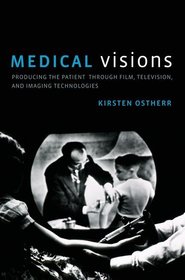
Medical Visions
Producing the Patient Through Film, Television, and Imaging Technologies
-
10% KEDVEZMÉNY?
- A kedvezmény csak az 'Értesítés a kedvenc témákról' hírlevelünk címzettjeinek rendeléseire érvényes.
- Kiadói listaár GBP 120.00
-
54 180 Ft (51 600 Ft + 5% áfa)
Az ár azért becsült, mert a rendelés pillanatában nem lehet pontosan tudni, hogy a beérkezéskor milyen lesz a forint árfolyama az adott termék eredeti devizájához képest. Ha a forint romlana, kissé többet, ha javulna, kissé kevesebbet kell majd fizetnie.
- Kedvezmény(ek) 10% (kb. 5 418 Ft)
- Kedvezményes ár 48 762 Ft (46 440 Ft + 5% áfa)
Iratkozzon fel most és részesüljön kedvezőbb árainkból!
Feliratkozom
54 180 Ft

Beszerezhetőség
Megrendelésre a kiadó utánnyomja a könyvet. Rendelhető, de a szokásosnál kicsit lassabban érkezik meg.
Why don't you give exact delivery time?
A beszerzés időigényét az eddigi tapasztalatokra alapozva adjuk meg. Azért becsült, mert a terméket külföldről hozzuk be, így a kiadó kiszolgálásának pillanatnyi gyorsaságától is függ. A megadottnál gyorsabb és lassabb szállítás is elképzelhető, de mindent megteszünk, hogy Ön a lehető leghamarabb jusson hozzá a termékhez.
A termék adatai:
- Kiadó OUP USA
- Megjelenés dátuma 2013. április 11.
- ISBN 9780199737246
- Kötéstípus Keménykötés
- Terjedelem320 oldal
- Méret 163x236x20 mm
- Súly 604 g
- Nyelv angol
- Illusztrációk 48 illus. 0
Kategóriák
Rövid leírás:
This book explores 120 years of medical image-making to explain how visual representations came to play a central role in medical education and practice. She demonstrates how medical images acquire cultural meaning and influence, shaping professional and popular understandings of health and disease.
TöbbHosszú leírás:
How do visual images shape the practice of medicine? What role does visual representation play in the cultivation of medical ways of seeing? How might the history of medical imaging technologies help us understand the future of medical media? How has medicine's visual culture changed in the digital age?
Kirsten Ostherr's ambitious book explores 120 years of medical image-making to explain how visual representations shape medical education and practice. She demonstrates how medical images created by the healthcare industry, documentary filmmakers, experimental artists and the mass media acquire cultural meaning and influence professional and popular understandings of health and disease. Her analysis proceeds chronologically, turning from the earliest experiments with medical filmmaking by the American College of Surgeons, to the place of health films in the "golden age" of instructional film in the 1960s. Ostherr considers the shift to television as the dominant medium of health education, highlighting the evolving status of realism, the techniques employed to bridge the entertainment-education divide, the role of expert consultants and sponsors, and the tradeoffs made by professionals to reach a broad audience. The role of newsmagazines forms a transition between the medical dramas of the 60s, 70s, and 80s (from Frederick Wiseman's Hospital to Marcus Welby, MD) and more recent reality shows like The Swan and Doctor 90210. Reality-based miniseries (Hopkins, Boston Med) continue the long cycle of comingling between professional and entertainment medicine. The study concludes with an in-depth look at the advertising, moving image, and social media circuits active in the health care setting today, closing with ten key lessons for the future of medical media.
In her opening paragraph, Ostherr describes Medical Visions as a book about medical visualizations and the new worlds they bring into being for both doctors and patients (p. 3). What follows is a fascinating exploration of 120 years of medical images created by parties as diverse as the healthcare industry, documentary makers and artists, which have raised questions about the identities and roles of doctors and patients, including about the doctor's gaze, whether mediated by technology or challenged by technology-driven patient empowerment such as e-patient movements.
Tartalomjegyzék:
Introduction: Medical Ways of Seeing
Chapter One: Visual Education, Health Communication, and Scientific Filmmaking in the Early Twentieth Century
Chapter Two: "The Entire Medical Profession Is Becoming 'Film Conscious'": How Cinema Became Part of Medical Education
Chapter Three: "The Disruption of Medical Education throughout the World": Global Networks for Medical Media in the Postwar Era
Chapter Four: From the Avant-Garde to Experimental Television: Mid-Century Technologies of Medical Perception
Chapter Five: Medical Relevance and Public Relations: How Cinéma Vérité Became the Video News Release
Chapter Six: Medical Reality TV, Social Media, and the Networked Patient
Conclusion: Ten Lessons for the Future of Medical Media
Bibliography

