

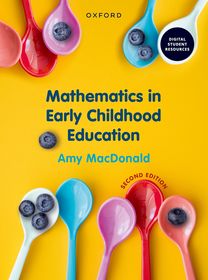
Mathematics in Early Childhood Education
-
10% KEDVEZMÉNY?
- A kedvezmény csak az 'Értesítés a kedvenc témákról' hírlevelünk címzettjeinek rendeléseire érvényes.
- Kiadói listaár GBP 56.99
-
25 730 Ft (24 505 Ft + 5% áfa)
Az ár azért becsült, mert a rendelés pillanatában nem lehet pontosan tudni, hogy a beérkezéskor milyen lesz a forint árfolyama az adott termék eredeti devizájához képest. Ha a forint romlana, kissé többet, ha javulna, kissé kevesebbet kell majd fizetnie.
- Kedvezmény(ek) 10% (cc. 2 573 Ft off)
- Kedvezményes ár 23 157 Ft (22 055 Ft + 5% áfa)
Iratkozzon fel most és részesüljön kedvezőbb árainkból!
Feliratkozom
25 730 Ft

Beszerezhetőség
Csak rendelésre kapható a kiadónál, kissé időigényes.
Why don't you give exact delivery time?
A beszerzés időigényét az eddigi tapasztalatokra alapozva adjuk meg. Azért becsült, mert a terméket külföldről hozzuk be, így a kiadó kiszolgálásának pillanatnyi gyorsaságától is függ. A megadottnál gyorsabb és lassabb szállítás is elképzelhető, de mindent megteszünk, hogy Ön a lehető leghamarabb jusson hozzá a termékhez.
A termék adatai:
- Kiadás sorszáma 2
- Kiadó OUP Australia & New Zealand
- Megjelenés dátuma 2023. december 14.
- ISBN 9780190338756
- Kötéstípus Puhakötés
- Terjedelem320 oldal
- Méret 254x189x13 mm
- Súly 638 g
- Nyelv angol 445
Kategóriák
Rövid leírás:
Explores mathematics in a range of early childhood contexts, including home, playgroup, childcare, preschool, and school to help pre-service teachers increase confidence and build up a comprehensive professional identity as a mathematics educator.
TöbbHosszú leírás:
A comprehensive guide to early childhood mathematics education.
Mathematics in Early Childhood Education explores mathematics in a range of early childhood contexts, including home, playgroup, childcare, preschool, and school.
The text provides many opportunities to engage children with mathematical concepts and processes through play, exploration, routines, and activities.
Part 1 frames the teaching of mathematics in early childhood education including chapters dedicated to curricula and theories.
Part 2 explains mathematics education approaches, including a strengths-based approach, and the importance of families and informal learning opportunities.
Part 3 provides learning experience plans on topics such as patterns, measurement, data, algebra, number, space and geometry.
Tartalomjegyzék:
Part 1: Framing the Teaching of Mathematics in Early Childhood Education
Chapter 1: Introduction to early childhood mathematics education
Chapter 2: Becoming an early childhood mathematics educator
Chapter 3: Theoretical bases for early childhood mathematics education
Chapter 4: Informal opportunities to learn about mathematics
Chapter 5: Early childhood mathematics curricula
Part 2: Approaches to Teaching Mathematics in Early Childhood Education
Chapter 6: Educator roles in mathematics education
Chapter 7: Working mathematically through powerful processes
Chapter 8: Mathematics and transitions to school
Chapter 9: Involving families in mathematics education
Chapter 10: Strengths approaches to early childhood mathematics education
Chapter 11: The relationship between assessment and planning
Part 3: Content for Teaching Mathematics in Early Childhood Education
Chapter 12: Patterns
Chapter 13: Space and geometry
Chapter 14: Measurement
Chapter 15: Number and algebra
Chapter 16: Data, statistics, and probability

