

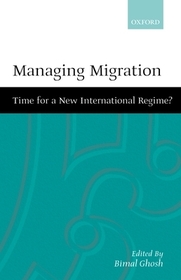
Managing Migration
Time for a New International Regime?
-
10% KEDVEZMÉNY?
- A kedvezmény csak az 'Értesítés a kedvenc témákról' hírlevelünk címzettjeinek rendeléseire érvényes.
- Kiadói listaár GBP 250.00
-
112 875 Ft (107 500 Ft + 5% áfa)
Az ár azért becsült, mert a rendelés pillanatában nem lehet pontosan tudni, hogy a beérkezéskor milyen lesz a forint árfolyama az adott termék eredeti devizájához képest. Ha a forint romlana, kissé többet, ha javulna, kissé kevesebbet kell majd fizetnie.
- Kedvezmény(ek) 10% (kb. 11 288 Ft)
- Kedvezményes ár 101 588 Ft (96 750 Ft + 5% áfa)
Iratkozzon fel most és részesüljön kedvezőbb árainkból!
Feliratkozom
112 875 Ft

Beszerezhetőség
Megrendelésre a kiadó utánnyomja a könyvet. Rendelhető, de a szokásosnál kicsit lassabban érkezik meg.
Why don't you give exact delivery time?
A beszerzés időigényét az eddigi tapasztalatokra alapozva adjuk meg. Azért becsült, mert a terméket külföldről hozzuk be, így a kiadó kiszolgálásának pillanatnyi gyorsaságától is függ. A megadottnál gyorsabb és lassabb szállítás is elképzelhető, de mindent megteszünk, hogy Ön a lehető leghamarabb jusson hozzá a termékhez.
A termék adatai:
- Kiadó OUP Oxford
- Megjelenés dátuma 2000. augusztus 3.
- ISBN 9780198297642
- Kötéstípus Keménykötés
- Terjedelem272 oldal
- Méret 241x163x20 mm
- Súly 505 g
- Nyelv angol 0
Kategóriák
Rövid leírás:
This ground-breaking study explores the issues and prospects of a multilateral response to the challenge of international migration. It presents within a single, cohesive framework, the views, perceptions, and critical analyses of a group of eminent specialists drawn from different disciplines but with an in-depth knowledge of migration issues.
TöbbHosszú leírás:
The present international migration system is failing to respond to the new challenges and opportunities that movements of people now present. Rising levels of migration and its increasingly complex pattern–marked by economic globalisation, a widening variety of source countries and unpredictable and intense flows–is making migration management more and more difficult.
Fears have been expressed that a breakdown of the migration system, already under heavy strain, could spell political and economic disaster, creating in its wake a major setback in human progress. Not surprisingly, there have been calls in recent years for the establishment of a more robust and comprehensive multilateral framework to help revamp the present fragmentary and predominantly reactive arrangements. But little systematic work has been done to develop this idea. The study takes up this challenge.
In this ground-breaking study, the issues and prospects of a multilateral response to the challenge of movements of people is explored. It presents, within a single, cohesive framework, the views, perceptions, and critical analyses of a group of eminent specialists drawn from different disciplines but with an in-depth knowledge of migration issues. It argues, that if a co-ordinated multilateral response is indeed necessary, what should be its exact configuration? In addressing this critical question, the book introduces the concept of an internationally harmonized migration regime, based on the principle of regulated openness - commonalty of policy objectives, harmonized normative principles and co-ordinated institutional arrangements.
This is a useful book ... such a collection emphasises the need for a vision, and for such a process to be informed by a thorough understanding of the complex issues facing contemporary migration, as represented by the high quality of the contributions in this volume
Tartalomjegyzék:
Introduction: Towards a new international regime for orderly movements of people
International migration in post-Cold War international relations
Globalisation, sovereignty and transnational regulation: Reshaping the governance of international migration
Migration and the new international order: The missing regime
Why do we need a General Agreement on Movements of People (GAMP)?
Migration outcomes of guestworker and free trade regimes: the case of Mexico-US migration
Migration - international law and human rights
Forced migration in the post-Cold War era: the need for a comprehensive approach
New international regime for orderly movements of people: What will it look like ?

