

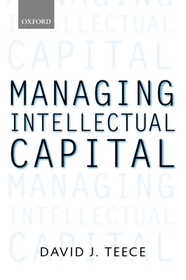
Managing Intellectual Capital
Organizational, Strategic, and Policy Dimensions
Sorozatcím: Clarendon Lectures in Management Studies;
-
10% KEDVEZMÉNY?
- A kedvezmény csak az 'Értesítés a kedvenc témákról' hírlevelünk címzettjeinek rendeléseire érvényes.
- Kiadói listaár GBP 40.99
-
18 506 Ft (17 625 Ft + 5% áfa)
Az ár azért becsült, mert a rendelés pillanatában nem lehet pontosan tudni, hogy a beérkezéskor milyen lesz a forint árfolyama az adott termék eredeti devizájához képest. Ha a forint romlana, kissé többet, ha javulna, kissé kevesebbet kell majd fizetnie.
- Kedvezmény(ek) 10% (cc. 1 851 Ft off)
- Kedvezményes ár 16 656 Ft (15 863 Ft + 5% áfa)
Iratkozzon fel most és részesüljön kedvezőbb árainkból!
Feliratkozom
18 506 Ft

Beszerezhetőség
Megrendelésre a kiadó utánnyomja a könyvet. Rendelhető, de a szokásosnál kicsit lassabban érkezik meg.
Why don't you give exact delivery time?
A beszerzés időigényét az eddigi tapasztalatokra alapozva adjuk meg. Azért becsült, mert a terméket külföldről hozzuk be, így a kiadó kiszolgálásának pillanatnyi gyorsaságától is függ. A megadottnál gyorsabb és lassabb szállítás is elképzelhető, de mindent megteszünk, hogy Ön a lehető leghamarabb jusson hozzá a termékhez.
A termék adatai:
- Kiadás sorszáma New ed
- Kiadó OUP Oxford
- Megjelenés dátuma 2002. március 21.
- ISBN 9780198295426
- Kötéstípus Puhakötés
- Terjedelem312 oldal
- Méret 234x157x17 mm
- Súly 457 g
- Nyelv angol
- Illusztrációk numerous tables and figures 0
Kategóriák
Rövid leírás:
The astute management of technology is essential for firms who wish to compete within the new economy. In this in-depth study, David Teece considers how firms can exploit technological innovation, protecting their intellectual capital, while staying ahead of the competition. Providing frameworks as well as practical advice, he looks in particular at the organization structures most likely to support innovation, and how managerial decisions and strategy affect the division of the gains. Essential reading for academics, managers, and students alike who want to keep abreast of contemporary strategic challenges.
TöbbHosszú leírás:
There is a strong awareness that the new economy has arrived, and that firms and management need to focus on a plethora of new issues at present only dimly perceived. The astute management of technology can advance not only the fortunes of the innovators, but also of society at large.
In this book, David Teece considers how firms can exploit technological innovation, protecting their intellectual capital, while staying ahead of the competition. He provides frameworks as well as practical advice, looking in particular at the organization structure most likely to support innovation, and how managerial decision and strategy affect the division of the gains.
This will be essential reading for academics, managers, and students alike who want to keep abreast of contemporary strategic challenges.
Teece's work provides an example of what can be achieved through high-quality analysis ... the thinking manager, as well as the student, will get much out of Teece's hardheaded approach to his subject matter, and there are significant lessons to be learned from the experience of innovating companies. All in all, this is a book to be strongly recommended.
Tartalomjegyzék:
Part I: Introduction
The Knowledge Economy and Intellectual Capital Management
Part II: Foundations
Impact of Market Structure and Organizational Factors on Innovation
Governance Modes and Technological Innovation
Decision-making Processes and the Rate and Direction of Innovation (with J. Bercovitz and J. de Figueiredo)
Part III: Applications to Management and Strategy
Market Entry Strategies for Innovators: Avoiding Pyrrhic Victories
Imitation Strategies for Owners of Complementary Assets
Outsourcing and Insourcing Strategies for Innovators: Opportunities and Limits (with H. Chesbrough)
Understanding the Licensing Option (with P. Grindley and E. Sherry)
Part IV: Public Policy
Antitrust Analysis in High Technology Industries (with M. Coleman)
Appendices: Case Studies in Licensing and Cross-Licensing
The Semiconductor Industry (with P. Grindley and E. Sherry)
The Glass Industry and the Pilkington Float Process (with E. Sherry and P. Grindley)

