

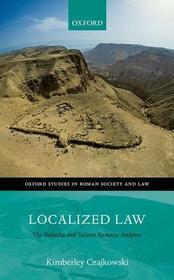
Localized Law
The Babatha and Salome Komaise Archives
Sorozatcím: Oxford Studies in Roman Society & Law;
-
10% KEDVEZMÉNY?
- A kedvezmény csak az 'Értesítés a kedvenc témákról' hírlevelünk címzettjeinek rendeléseire érvényes.
- Kiadói listaár GBP 110.00
-
49 665 Ft (47 300 Ft + 5% áfa)
Az ár azért becsült, mert a rendelés pillanatában nem lehet pontosan tudni, hogy a beérkezéskor milyen lesz a forint árfolyama az adott termék eredeti devizájához képest. Ha a forint romlana, kissé többet, ha javulna, kissé kevesebbet kell majd fizetnie.
- Kedvezmény(ek) 10% (kb. 4 967 Ft)
- Kedvezményes ár 44 699 Ft (42 570 Ft + 5% áfa)
Iratkozzon fel most és részesüljön kedvezőbb árainkból!
Feliratkozom
49 665 Ft

Beszerezhetőség
Megrendelésre a kiadó utánnyomja a könyvet. Rendelhető, de a szokásosnál kicsit lassabban érkezik meg.
Why don't you give exact delivery time?
A beszerzés időigényét az eddigi tapasztalatokra alapozva adjuk meg. Azért becsült, mert a terméket külföldről hozzuk be, így a kiadó kiszolgálásának pillanatnyi gyorsaságától is függ. A megadottnál gyorsabb és lassabb szállítás is elképzelhető, de mindent megteszünk, hogy Ön a lehető leghamarabb jusson hozzá a termékhez.
A termék adatai:
- Kiadó OUP Oxford
- Megjelenés dátuma 2017. január 5.
- ISBN 9780198777335
- Kötéstípus Keménykötés
- Terjedelem254 oldal
- Méret 222x141x19 mm
- Súly 416 g
- Nyelv angol 0
Kategóriák
Rövid leírás:
Localized Law examines the legal archives of Babatha and Salome Komaise, which offer a window onto the practice of law in Maoza as it came under the control of the Roman Empire. A series of case studies of the various agents involved in the legal transactions illuminates the legal culture of this community and its practice of law and justice.
TöbbHosszú leírás:
In the early second century CE, two Jewish women, Babatha and Salome Komaise, lived in the village of Maoza on the southern coast of the Dead Sea. This was first part of the Nabataean Kingdom, but came under direct Roman rule in 106 CE as part of the province of Roman Arabia. The archives these two women left behind not only provide a tantalizing glimpse into their legal lives and those of their families, but also offer a vivid window onto the ways in which the inhabitants of this region interacted with their new rulers and how this affected the practice of law in this part of the Roman Empire.
The papers in these archives are remarkable in their legal diversity, detailing Babatha and Salome Komaise's property and marriages, as well as their disputes. Nabataean, Roman, Greek, and Jewish legal elements are all in evidence, and are often combined within a single papyrus. As such, identifying the supposed 'operative law' of the documents has proven a highly contentious task: scholarly advocates of each of these traditions have failed to reach any true consensus and there remains division particularly between those who argue for a 'Roman' versus a 'Jewish' framework. Taking its lead from recent advances in the scholarship of Roman law, this volume proposes a change in focus: instead of attempting to identify the 'legal system' behind the documents, it seeks instead to understand the 'legal culture' of the community that produced them. Through a series of case studies of the people involved in the creation of the papyri - the scribes, legal advisors, local arbitrators, Roman judges, and the litigants themselves - we can build up a picture of the ways in which they variously perceived and approached the legal transactions, and thus of legal practice itself as being heavily influenced by the particular agents involved. This study therefore moves away from a systematic approach towards an historical study of ideas, attitudes, and perceptions of law, arguing that concentration on different agents' understandings will ultimately help scholars to better understand the actual functioning of law and justice in this particular localized legal culture and in other similar small communities in the Roman Empire.
Czajkowski has thus produced a reliable study which serves as an ideal introduction to a vital set of evidence.
Tartalomjegyzék:
Frontmatter
List of Tables
List of Abbreviations
Introduction
The Archives
'Provincialization' and Roman Law
Multi-Legalisms, 'Legal Culture', and a 'Ground-Up' Approach
The Archives within this Multi-Legal Approach
Beginning to Re-Interpret the Archives
The Tales Told in the Archives
Case Studies
Concluding Remarks
The Scribes
Reasons for Hiring a Scribe
The Identity of the Scribes
Legal Advisors
Legal Advisors in the Ancient World
The Archives
Scribes and Advisors: A Purely Terminological Distinction?
The Parties
The Non-Greek Documents
The Point of Change
The Greek Documents
The Alternatives to the Assizes?
Local Tribunals: A Socio-Anthropological Perspective
The Possible Venues and Authorities for Alternative Legal Fora
Local Tribunals and Roman Imperial Power: Effects and Interaction
The Roman Officials
The Roman Governor in the Provinces
The Roman Governor in the Archives
The Spectre of the Roman Court
Conclusion
Endmatter
Bibliography
Index

