

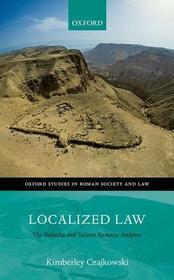
Localized Law
The Babatha and Salome Komaise Archives
Series: Oxford Studies in Roman Society & Law;
- Publisher's listprice GBP 110.00
-
49 665 Ft (47 300 Ft + 5% VAT)
The price is estimated because at the time of ordering we do not know what conversion rates will apply to HUF / product currency when the book arrives. In case HUF is weaker, the price increases slightly, in case HUF is stronger, the price goes lower slightly.
- Discount 10% (cc. 4 967 Ft off)
- Discounted price 44 699 Ft (42 570 Ft + 5% VAT)
Subcribe now and take benefit of a favourable price.
Subscribe
49 665 Ft

Availability
printed on demand
Why don't you give exact delivery time?
Delivery time is estimated on our previous experiences. We give estimations only, because we order from outside Hungary, and the delivery time mainly depends on how quickly the publisher supplies the book. Faster or slower deliveries both happen, but we do our best to supply as quickly as possible.
Product details:
- Publisher OUP Oxford
- Date of Publication 5 January 2017
- ISBN 9780198777335
- Binding Hardback
- No. of pages254 pages
- Size 222x141x19 mm
- Weight 416 g
- Language English 0
Categories
Short description:
Localized Law examines the legal archives of Babatha and Salome Komaise, which offer a window onto the practice of law in Maoza as it came under the control of the Roman Empire. A series of case studies of the various agents involved in the legal transactions illuminates the legal culture of this community and its practice of law and justice.
MoreLong description:
In the early second century CE, two Jewish women, Babatha and Salome Komaise, lived in the village of Maoza on the southern coast of the Dead Sea. This was first part of the Nabataean Kingdom, but came under direct Roman rule in 106 CE as part of the province of Roman Arabia. The archives these two women left behind not only provide a tantalizing glimpse into their legal lives and those of their families, but also offer a vivid window onto the ways in which the inhabitants of this region interacted with their new rulers and how this affected the practice of law in this part of the Roman Empire.
The papers in these archives are remarkable in their legal diversity, detailing Babatha and Salome Komaise's property and marriages, as well as their disputes. Nabataean, Roman, Greek, and Jewish legal elements are all in evidence, and are often combined within a single papyrus. As such, identifying the supposed 'operative law' of the documents has proven a highly contentious task: scholarly advocates of each of these traditions have failed to reach any true consensus and there remains division particularly between those who argue for a 'Roman' versus a 'Jewish' framework. Taking its lead from recent advances in the scholarship of Roman law, this volume proposes a change in focus: instead of attempting to identify the 'legal system' behind the documents, it seeks instead to understand the 'legal culture' of the community that produced them. Through a series of case studies of the people involved in the creation of the papyri - the scribes, legal advisors, local arbitrators, Roman judges, and the litigants themselves - we can build up a picture of the ways in which they variously perceived and approached the legal transactions, and thus of legal practice itself as being heavily influenced by the particular agents involved. This study therefore moves away from a systematic approach towards an historical study of ideas, attitudes, and perceptions of law, arguing that concentration on different agents' understandings will ultimately help scholars to better understand the actual functioning of law and justice in this particular localized legal culture and in other similar small communities in the Roman Empire.
Czajkowski has thus produced a reliable study which serves as an ideal introduction to a vital set of evidence.
Table of Contents:
Frontmatter
List of Tables
List of Abbreviations
Introduction
The Archives
'Provincialization' and Roman Law
Multi-Legalisms, 'Legal Culture', and a 'Ground-Up' Approach
The Archives within this Multi-Legal Approach
Beginning to Re-Interpret the Archives
The Tales Told in the Archives
Case Studies
Concluding Remarks
The Scribes
Reasons for Hiring a Scribe
The Identity of the Scribes
Legal Advisors
Legal Advisors in the Ancient World
The Archives
Scribes and Advisors: A Purely Terminological Distinction?
The Parties
The Non-Greek Documents
The Point of Change
The Greek Documents
The Alternatives to the Assizes?
Local Tribunals: A Socio-Anthropological Perspective
The Possible Venues and Authorities for Alternative Legal Fora
Local Tribunals and Roman Imperial Power: Effects and Interaction
The Roman Officials
The Roman Governor in the Provinces
The Roman Governor in the Archives
The Spectre of the Roman Court
Conclusion
Endmatter
Bibliography
Index

