

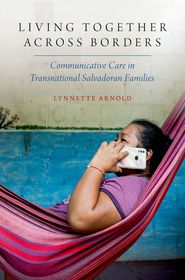
Living Together Across Borders
Communicative Care in Transnational Salvadoran Families
Sorozatcím: Oxford Studies in the Anthropology of Language;
-
10% KEDVEZMÉNY?
- A kedvezmény csak az 'Értesítés a kedvenc témákról' hírlevelünk címzettjeinek rendeléseire érvényes.
- Kiadói listaár GBP 7.99
-
3 607 Ft (3 435 Ft + 5% áfa)
Az ár azért becsült, mert a rendelés pillanatában nem lehet pontosan tudni, hogy a beérkezéskor milyen lesz a forint árfolyama az adott termék eredeti devizájához képest. Ha a forint romlana, kissé többet, ha javulna, kissé kevesebbet kell majd fizetnie.
- Kedvezmény(ek) 10% (kb. 361 Ft)
- Kedvezményes ár 3 246 Ft (3 092 Ft + 5% áfa)
Iratkozzon fel most és részesüljön kedvezőbb árainkból!
Feliratkozom
3 607 Ft

Beszerezhetőség
Becsült beszerzési idő: A Prosperónál jelenleg nincsen raktáron, de a kiadónál igen. Beszerzés kb. 3-5 hét..
A Prosperónál jelenleg nincsen raktáron.
Why don't you give exact delivery time?
A beszerzés időigényét az eddigi tapasztalatokra alapozva adjuk meg. Azért becsült, mert a terméket külföldről hozzuk be, így a kiadó kiszolgálásának pillanatnyi gyorsaságától is függ. A megadottnál gyorsabb és lassabb szállítás is elképzelhető, de mindent megteszünk, hogy Ön a lehető leghamarabb jusson hozzá a termékhez.
A termék adatai:
- Kiadó OUP USA
- Megjelenés dátuma 2025. április 23.
- ISBN 9780197755747
- Kötéstípus Puhakötés
- Terjedelem248 oldal
- Méret 226x150x17 mm
- Súly 363 g
- Nyelv angol 581
Kategóriák
Rövid leírás:
Living Together Across Borders: Care Through Communication in Separated Salvadoran Families tells the stories of extended families living stretched between a rural Salvadoran village and the urban locations in the United States where their migrant relatives live. Author Lynnette Arnold focuses on their cross-border conversations, demonstrating that this communication is a vital resource for enacting care-at-a-distance. She examines seemingly mundane interactions including greetings, remittance negotiations, and reminiscing together. Arnold demonstrates that while these practices are distributed in ways that reinforce boundaries between migrant and non-migrant relatives, families simultaneously use these same practices to build convivencia (living-together) despite ongoing separation.
TöbbHosszú leírás:
In Living Together Across Borders, author Lynnette Arnold tells the stories of extended families living stretched between a rural Salvadoran village and the urban locations in the United States where their migrant relatives live. In this multi-sited ethnography, Arnold examines seemingly mundane conversational practices-such as sending greetings, negotiating remittances, and reminiscing together-that are central to family life across borders. Arnold underscores the consequentiality of these linguistic practices by tracing how they are shaped by and re-shape gendered and generational norms of family care, as well as how they are tied to Salvadoran histories of migration, violence, and poverty, which are powerfully influenced by U.S. economic and foreign policy.
This book demonstrates that these communicative practices bring inequities between the global North and South into family life by continually reproducing distinctions between relatives in El Salvador and those living in the United States. Conversely, she examines seemingly mundane interactions including greetings, remittance negotiations, and reminiscing together. Although these relational moments of cross-border connection are fleeting, their impacts endure, laying the foundation for the ongoing material and economic provisioning necessary to family survival. Through cross-border conversations, families nurture intergenerational relations that sustain the family and convivencia (living-together) over the years despite ongoing separation.
Despite the inequities and complications of living apart, Arnold affirms that migrants and non-migrants alike can create conviviencia (living together) in the face of persistent separation...Recommended.
Tartalomjegyzék:
Dedication
Acknowledgements
Prologue: Why I wrote this book
Introduction: Communication and Care-at-a-Distance
Chapter 1. Making family care political: State-endorsed migration discourse in El Salvador
Chapter 2. Transnational care in multigenerational households: Asymmetrical practices and moral meanings
Chapter 3. ---Les Mando Saludos---: Sending greetings, envisioning family, and grappling with inequality
Chapter 4. Talking remittances: The conversational temporalities of intergenerational care
Chapter 5. Communicative memory: Defying institutional forgetting through remembering as care
Conclusion: Social change through communicative care
Appendix 1. Transcription Conventions
References

