

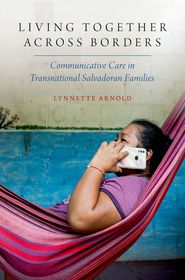
Living Together Across Borders
Communicative Care in Transnational Salvadoran Families
Series: Oxford Studies in the Anthropology of Language;
- Publisher's listprice GBP 7.99
-
3 607 Ft (3 435 Ft + 5% VAT)
The price is estimated because at the time of ordering we do not know what conversion rates will apply to HUF / product currency when the book arrives. In case HUF is weaker, the price increases slightly, in case HUF is stronger, the price goes lower slightly.
- Discount 10% (cc. 361 Ft off)
- Discounted price 3 246 Ft (3 092 Ft + 5% VAT)
Subcribe now and take benefit of a favourable price.
Subscribe
3 607 Ft

Availability
Estimated delivery time: In stock at the publisher, but not at Prospero's office. Delivery time approx. 3-5 weeks.
Not in stock at Prospero.
Why don't you give exact delivery time?
Delivery time is estimated on our previous experiences. We give estimations only, because we order from outside Hungary, and the delivery time mainly depends on how quickly the publisher supplies the book. Faster or slower deliveries both happen, but we do our best to supply as quickly as possible.
Product details:
- Publisher OUP USA
- Date of Publication 23 April 2025
- ISBN 9780197755747
- Binding Paperback
- No. of pages248 pages
- Size 226x150x17 mm
- Weight 363 g
- Language English 581
Categories
Short description:
Living Together Across Borders: Care Through Communication in Separated Salvadoran Families tells the stories of extended families living stretched between a rural Salvadoran village and the urban locations in the United States where their migrant relatives live. Author Lynnette Arnold focuses on their cross-border conversations, demonstrating that this communication is a vital resource for enacting care-at-a-distance. She examines seemingly mundane interactions including greetings, remittance negotiations, and reminiscing together. Arnold demonstrates that while these practices are distributed in ways that reinforce boundaries between migrant and non-migrant relatives, families simultaneously use these same practices to build convivencia (living-together) despite ongoing separation.
MoreLong description:
In Living Together Across Borders, author Lynnette Arnold tells the stories of extended families living stretched between a rural Salvadoran village and the urban locations in the United States where their migrant relatives live. In this multi-sited ethnography, Arnold examines seemingly mundane conversational practices-such as sending greetings, negotiating remittances, and reminiscing together-that are central to family life across borders. Arnold underscores the consequentiality of these linguistic practices by tracing how they are shaped by and re-shape gendered and generational norms of family care, as well as how they are tied to Salvadoran histories of migration, violence, and poverty, which are powerfully influenced by U.S. economic and foreign policy.
This book demonstrates that these communicative practices bring inequities between the global North and South into family life by continually reproducing distinctions between relatives in El Salvador and those living in the United States. Conversely, she examines seemingly mundane interactions including greetings, remittance negotiations, and reminiscing together. Although these relational moments of cross-border connection are fleeting, their impacts endure, laying the foundation for the ongoing material and economic provisioning necessary to family survival. Through cross-border conversations, families nurture intergenerational relations that sustain the family and convivencia (living-together) over the years despite ongoing separation.
Despite the inequities and complications of living apart, Arnold affirms that migrants and non-migrants alike can create conviviencia (living together) in the face of persistent separation...Recommended.
Table of Contents:
Dedication
Acknowledgements
Prologue: Why I wrote this book
Introduction: Communication and Care-at-a-Distance
Chapter 1. Making family care political: State-endorsed migration discourse in El Salvador
Chapter 2. Transnational care in multigenerational households: Asymmetrical practices and moral meanings
Chapter 3. ---Les Mando Saludos---: Sending greetings, envisioning family, and grappling with inequality
Chapter 4. Talking remittances: The conversational temporalities of intergenerational care
Chapter 5. Communicative memory: Defying institutional forgetting through remembering as care
Conclusion: Social change through communicative care
Appendix 1. Transcription Conventions
References

