

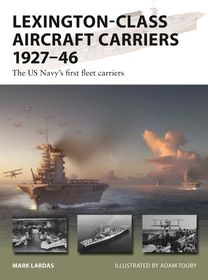
Lexington-Class Aircraft Carriers 1927?46
The US Navy's first fleet carriers
Sorozatcím: New Vanguard; 352;
-
18% KEDVEZMÉNY?
- Kiadói listaár GBP 12.99
-
5 864 Ft (5 585 Ft + 5% áfa)
Az ár azért becsült, mert a rendelés pillanatában nem lehet pontosan tudni, hogy a beérkezéskor milyen lesz a forint árfolyama az adott termék eredeti devizájához képest. Ha a forint romlana, kissé többet, ha javulna, kissé kevesebbet kell majd fizetnie.
- Kedvezmény(ek) 18% (cc. 1 Ft off)
- Kedvezményes ár 4 809 Ft (4 580 Ft + 5% áfa)
- A kedvezmény érvényes eddig: 2026. augusztus 31.
4 809 Ft

Beszerezhetőség
Még nem jelent meg, de rendelhető. A megjelenéstől számított néhány héten belül megérkezik.
Why don't you give exact delivery time?
A beszerzés időigényét az eddigi tapasztalatokra alapozva adjuk meg. Azért becsült, mert a terméket külföldről hozzuk be, így a kiadó kiszolgálásának pillanatnyi gyorsaságától is függ. A megadottnál gyorsabb és lassabb szállítás is elképzelhető, de mindent megteszünk, hogy Ön a lehető leghamarabb jusson hozzá a termékhez.
A termék adatai:
- Kiadó Bloomsbury Publishing (UK)
- Megjelenés dátuma 2026. október 22.
- ISBN 9781472870896
- Kötéstípus Puhakötés
- Terjedelem48 oldal
- Méret 248x184 mm
- Súly 454 g
- Nyelv angol
- Illusztrációk Illustrated throughout with 40 photos and 8 pages of colour illustrations 700
Kategóriák
Rövid leírás:
This fully illustrated study explores the history of the Lexington class, the US Navy's first fleet carriers, from their battlecruiser origins to their service in World War II.
TöbbHosszú leírás:
This fully illustrated study explores the history of the Lexington class, the US Navy's first fleet carriers, from their battlecruiser origins to their service in World War II.
The Lexington class began life as two of the six battlecruisers ordered for the US Navy in 1916. Laid down in 1920-21, they would have been the most powerful battlecruisers ever, if the Washington Naval Treaty had not scrapped the world's newest capital ships. However, as a handful of hulls were permitted to become aircraft carriers, Lexington and Saratoga were spared for conversion.
Naval historian Mark Lardas explains how the resulting design was unprecedented. When built they were the largest carriers in existence - the US Navy would not have bigger carriers until the 1945 Midway class. They were fast, they carried larger air groups than any other carrier of their time, and they pioneered a flight deck design that became standard in all future carriers. During the 1930s, they were at the heart of the fleet exercises that developed US carrier doctrine.
Illustrated with archive photos and superb artwork of the ships through their careers, this book also explores their wartime service. Lexington took part in the carrier raids of early 1942 before being sunk at Coral Sea, while Saratoga fought in many of the key Pacific campaigns, developing night carrier operations in 1944 and 1945, before being sunk as an A-bomb target in Operation Crossroads.
Tartalomjegyzék:
INTRODUCTION
DESIGN AND DEVELOPMENT
Origins
Design
Foreign contemporaries
Equipment
UPGRADES AND MODIFICATIONS
Peacetime refits
Wartime rebuilds
Radar
OPERATIONAL HISTORY
The pioneer years: 1925-1931
The doctrine development years: 1932-1938
The war year: 1939-1945
Operation Crossroads
FURTHER READING
INDEX

