

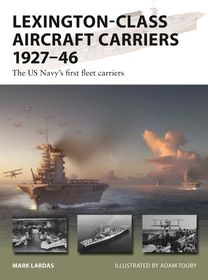
Lexington-Class Aircraft Carriers 1927?46
The US Navy's first fleet carriers
Series: New Vanguard; 352;
-
GET 18% OFF
- Publisher's listprice GBP 12.99
-
5 864 Ft (5 585 Ft + 5% VAT)
The price is estimated because at the time of ordering we do not know what conversion rates will apply to HUF / product currency when the book arrives. In case HUF is weaker, the price increases slightly, in case HUF is stronger, the price goes lower slightly.
- Discount 18% (cc. 1 Ft off)
- Discounted price 4 809 Ft (4 580 Ft + 5% VAT)
- Discount is valid until: 31 August 2026
4 809 Ft

Availability
Not yet published.
Why don't you give exact delivery time?
Delivery time is estimated on our previous experiences. We give estimations only, because we order from outside Hungary, and the delivery time mainly depends on how quickly the publisher supplies the book. Faster or slower deliveries both happen, but we do our best to supply as quickly as possible.
Product details:
- Publisher Bloomsbury Publishing (UK)
- Date of Publication 22 October 2026
- ISBN 9781472870896
- Binding Paperback
- No. of pages48 pages
- Size 248x184 mm
- Weight 454 g
- Language English
- Illustrations Illustrated throughout with 40 photos and 8 pages of colour illustrations 700
Categories
Short description:
This fully illustrated study explores the history of the Lexington class, the US Navy's first fleet carriers, from their battlecruiser origins to their service in World War II.
MoreLong description:
This fully illustrated study explores the history of the Lexington class, the US Navy's first fleet carriers, from their battlecruiser origins to their service in World War II.
The Lexington class began life as two of the six battlecruisers ordered for the US Navy in 1916. Laid down in 1920-21, they would have been the most powerful battlecruisers ever, if the Washington Naval Treaty had not scrapped the world's newest capital ships. However, as a handful of hulls were permitted to become aircraft carriers, Lexington and Saratoga were spared for conversion.
Naval historian Mark Lardas explains how the resulting design was unprecedented. When built they were the largest carriers in existence - the US Navy would not have bigger carriers until the 1945 Midway class. They were fast, they carried larger air groups than any other carrier of their time, and they pioneered a flight deck design that became standard in all future carriers. During the 1930s, they were at the heart of the fleet exercises that developed US carrier doctrine.
Illustrated with archive photos and superb artwork of the ships through their careers, this book also explores their wartime service. Lexington took part in the carrier raids of early 1942 before being sunk at Coral Sea, while Saratoga fought in many of the key Pacific campaigns, developing night carrier operations in 1944 and 1945, before being sunk as an A-bomb target in Operation Crossroads.
Table of Contents:
INTRODUCTION
DESIGN AND DEVELOPMENT
Origins
Design
Foreign contemporaries
Equipment
UPGRADES AND MODIFICATIONS
Peacetime refits
Wartime rebuilds
Radar
OPERATIONAL HISTORY
The pioneer years: 1925-1931
The doctrine development years: 1932-1938
The war year: 1939-1945
Operation Crossroads
FURTHER READING
INDEX

