

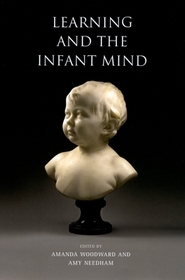
Learning and the Infant Mind
-
10% KEDVEZMÉNY?
- A kedvezmény csak az 'Értesítés a kedvenc témákról' hírlevelünk címzettjeinek rendeléseire érvényes.
- Kiadói listaár GBP 61.00
-
27 541 Ft (26 230 Ft + 5% áfa)
Az ár azért becsült, mert a rendelés pillanatában nem lehet pontosan tudni, hogy a beérkezéskor milyen lesz a forint árfolyama az adott termék eredeti devizájához képest. Ha a forint romlana, kissé többet, ha javulna, kissé kevesebbet kell majd fizetnie.
- Kedvezmény(ek) 10% (kb. 2 754 Ft)
- Kedvezményes ár 24 787 Ft (23 607 Ft + 5% áfa)
Iratkozzon fel most és részesüljön kedvezőbb árainkból!
Feliratkozom
27 541 Ft

Beszerezhetőség
Megrendelésre a kiadó utánnyomja a könyvet. Rendelhető, de a szokásosnál kicsit lassabban érkezik meg.
Why don't you give exact delivery time?
A beszerzés időigényét az eddigi tapasztalatokra alapozva adjuk meg. Azért becsült, mert a terméket külföldről hozzuk be, így a kiadó kiszolgálásának pillanatnyi gyorsaságától is függ. A megadottnál gyorsabb és lassabb szállítás is elképzelhető, de mindent megteszünk, hogy Ön a lehető leghamarabb jusson hozzá a termékhez.
A termék adatai:
- Kiadó OUP USA
- Megjelenés dátuma 2008. október 16.
- ISBN 9780195301151
- Kötéstípus Keménykötés
- Terjedelem352 oldal
- Méret 234x155x33 mm
- Súly 635 g
- Nyelv angol
- Illusztrációk 50 halftones, 100 line illus. 0
Kategóriák
Hosszú leírás:
When asking how cognition comes to take its mature form, learning seems to be an obvious factor to consider. However, until quite recently, there has been very little contact between investigations of how infants learn and what infants know. For example, on the one hand, research efforts focused on infants' foundational conceptual knowledge-what they know about the physical permanence of objects, causal relations, and human intentions-often do not consider how learning may contribute to the structure of this knowledge. On the other hand, research efforts focused on infants' perceptual and motor learning-how they extract information from the environment, tune their behavior patterns according to this information, and generalize learning to new situations-often do not consider the potential impacts of these perceptual and learning mechanisms the structure of conceptual knowledge.
Although each of these research efforts has made significant progress, this research has done little to narrow the divide between the disparate traditions of learning and knowledge. The chapters in this book document, for the first time, the insights that emerge when researchers who come from diverse domains and use different approaches make a genuine attempt to bridge this divide. The authors consider both infants' knowledge across domains, including knowledge of objects, physical relations between objects, categories, people, and language, and learning broadly construed, bringing to bear direct laboratory manipulations of learning and more general considerations of the relations between experience and knowledge.
These authors have begun to consider whether and how the products of learning "go beyond" the input in several senses. As a result, several converging trends emerge across Whese diverse points of view. These authors have begun to investigate whether infants derive relatively abstract representations from experience, as well as the extent to which infants generalize information learned in one context to a new context. They have also begun to investigate the extent to which learning is generative, constraining and informing subsequent learning.
Tartalomjegyzék:
Contributors
Introduction Amanda Woodward and Amy Needham
Learning and Memory: Like a Horse and Carriage
Patricia J. Bauer
What can Statistical Learning Tell us about Infant Learning?
Jenny R. Saffran
Developmental Origins of Object Perception
Scott P. Johnson
An Account of Infants' Physical Reasoning
Renee Baillargeon, Jie Li, Weiting Ng, Sylvia Yuan
Experience Primes Infants to Individuate Objects: Illuminating Learning Mechanisms
Teresa Wilcox and Rebecca Woods
How infants learn categories
Lisa M. Oakes, Jessica S. Horst, Kristine A. Kovach-Lesh, and Sammy Perone
Multiple Learning Mechanisms in the Development of Action
Karen E. Adolph and Amy S. Joh
Learning in Infants' Object Perception, Object-directed Action, and Tool Use
Amy Needham
Infants' Learning about Intentional Action
Amanda Woodward
Early Word Learning and Other Seemingly Symbolic Behaviors
Laura L. Namy
Symbol-based Learning in Infancy
Judy S. DeLoache and Patricia A. Ganea
The Role of Learning in Cognitive Development: Challenges and Prospects
Richard N. Aslin

