

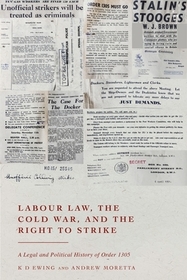
Labour Law, the Cold War, and the Right to Strike
A Legal and Political History of Order 1305
-
18% KEDVEZMÉNY?
- Kiadói listaár GBP 95.00
-
45 386 Ft (43 225 Ft + 5% áfa)
Az ár azért becsült, mert a rendelés pillanatában nem lehet pontosan tudni, hogy a beérkezéskor milyen lesz a forint árfolyama az adott termék eredeti devizájához képest. Ha a forint romlana, kissé többet, ha javulna, kissé kevesebbet kell majd fizetnie.
- Kedvezmény(ek) 18% (cc. 8 169 Ft off)
- Kedvezményes ár 37 217 Ft (35 445 Ft + 5% áfa)
- A kedvezmény érvényes eddig: 2026. március 31.
37 217 Ft

Beszerezhetőség
Még nem jelent meg, de rendelhető. A megjelenéstől számított néhány héten belül megérkezik.
Why don't you give exact delivery time?
A beszerzés időigényét az eddigi tapasztalatokra alapozva adjuk meg. Azért becsült, mert a terméket külföldről hozzuk be, így a kiadó kiszolgálásának pillanatnyi gyorsaságától is függ. A megadottnál gyorsabb és lassabb szállítás is elképzelhető, de mindent megteszünk, hogy Ön a lehető leghamarabb jusson hozzá a termékhez.
A termék adatai:
- Kiadó Bloomsbury Publishing (UK)
- Megjelenés dátuma 2026. május 14.
- ISBN 9781509983162
- Kötéstípus Keménykötés
- Terjedelem384 oldal
- Méret 234x156 mm
- Nyelv 700
Kategóriák
Rövid leírás:
Examines the origins, deployment, and legacy of Order 1305, a measure introduced in 1940 to make it a criminal offence to take part in a strike.
TöbbHosszú leírás:
This book examines the origins, deployment, and legacy of Order 1305, a measure introduced in 1940 to make it a criminal offence to take part in a strike.
Surprisingly, the prohibition on the right to strike was retained by the Attlee administration after the Second World War, and was transformed to become a weapon of government during the Cold War to deal with what were wrongly claimed by ministers to be Communist-inspired strikes engineered for subversive purposes.
In a deep analysis of Order 1305, the authors provide a reassessment of the role of the State in industrial relations. Challenging much contemporary learning in labour law, the book is informed by a very detailed engagement with Cabinet and ministerial papers, which highlight the contradictions on the part of government in simultaneously promoting and containing trade union power. These sources also highlight the extent to which trade unions both relied on and were co-opted by the State.
The main focus of the book, however, is the role of Order 1305 in the control of trade union activists. Allegations of Communist-inspired strikes and the role of the criminal law provided an important function in post-war industrial relations for MI5 and Special Branch. Material unearthed at the National Archives demonstrates unequivocally not only that trade unions were deeply penetrated, but also that trade union activists were the subject of extensive surveillance, as the authors fully reveal.
Tartalomjegyzék:
Part I: Introduction
1. Introduction
Part II: Order 1305 in Wartime
2. Order 1305 and the Right to Strike: England and Wales
3. Order 1305 and the Right to Strike: Scotland and Northern Ireland
Part III: Retention of Order 1305: The Labour Government after the War
4. Creating the Legal Framework: Retention of Order 1305
5. Containing Trade Union Power: Collective Bargaining and the Wage Restraint Bargain
6. Controlling Trade Union Activists: MI5 and Special Branch
Part IV: Revival of Order 1305: Unofficial Action as Economic and Political Subversion
7. The Re-Emergence of Order 1305
8. Preparing for Prosecution: Surveillance and Co-ordination
9. London Gas-workers: An Unexpected Prosecution
10. Prosecution Over-reached: The Gas-workers' Appeal
Part V: Revocation of Order 1305: Victory for the Port Workers' Committee
11. Order 1305 and the Cabinet: Legal and Political Pressures
12. The Cabinet Review of Order 1305: Irreconcilable Ministerial Tensions
13. Prosecuting the Port Workers' Committee: The Trial Collapses
14. Revocation and Legacy of Order 1305
Part VI: Conclusion
15. Conclusion

