

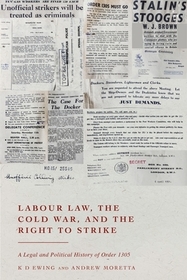
Labour Law, the Cold War, and the Right to Strike
A Legal and Political History of Order 1305
-
GET 18% OFF
- Publisher's listprice GBP 95.00
-
45 386 Ft (43 225 Ft + 5% VAT)
The price is estimated because at the time of ordering we do not know what conversion rates will apply to HUF / product currency when the book arrives. In case HUF is weaker, the price increases slightly, in case HUF is stronger, the price goes lower slightly.
- Discount 18% (cc. 8 169 Ft off)
- Discounted price 37 217 Ft (35 445 Ft + 5% VAT)
- Discount is valid until: 31 March 2026
37 217 Ft

Availability
Not yet published.
Why don't you give exact delivery time?
Delivery time is estimated on our previous experiences. We give estimations only, because we order from outside Hungary, and the delivery time mainly depends on how quickly the publisher supplies the book. Faster or slower deliveries both happen, but we do our best to supply as quickly as possible.
Product details:
- Publisher Bloomsbury Publishing (UK)
- Date of Publication 14 May 2026
- ISBN 9781509983162
- Binding Hardback
- No. of pages384 pages
- Size 234x156 mm
- Language 700
Categories
Short description:
Examines the origins, deployment, and legacy of Order 1305, a measure introduced in 1940 to make it a criminal offence to take part in a strike.
MoreLong description:
This book examines the origins, deployment, and legacy of Order 1305, a measure introduced in 1940 to make it a criminal offence to take part in a strike.
Surprisingly, the prohibition on the right to strike was retained by the Attlee administration after the Second World War, and was transformed to become a weapon of government during the Cold War to deal with what were wrongly claimed by ministers to be Communist-inspired strikes engineered for subversive purposes.
In a deep analysis of Order 1305, the authors provide a reassessment of the role of the State in industrial relations. Challenging much contemporary learning in labour law, the book is informed by a very detailed engagement with Cabinet and ministerial papers, which highlight the contradictions on the part of government in simultaneously promoting and containing trade union power. These sources also highlight the extent to which trade unions both relied on and were co-opted by the State.
The main focus of the book, however, is the role of Order 1305 in the control of trade union activists. Allegations of Communist-inspired strikes and the role of the criminal law provided an important function in post-war industrial relations for MI5 and Special Branch. Material unearthed at the National Archives demonstrates unequivocally not only that trade unions were deeply penetrated, but also that trade union activists were the subject of extensive surveillance, as the authors fully reveal.
Table of Contents:
Part I: Introduction
1. Introduction
Part II: Order 1305 in Wartime
2. Order 1305 and the Right to Strike: England and Wales
3. Order 1305 and the Right to Strike: Scotland and Northern Ireland
Part III: Retention of Order 1305: The Labour Government after the War
4. Creating the Legal Framework: Retention of Order 1305
5. Containing Trade Union Power: Collective Bargaining and the Wage Restraint Bargain
6. Controlling Trade Union Activists: MI5 and Special Branch
Part IV: Revival of Order 1305: Unofficial Action as Economic and Political Subversion
7. The Re-Emergence of Order 1305
8. Preparing for Prosecution: Surveillance and Co-ordination
9. London Gas-workers: An Unexpected Prosecution
10. Prosecution Over-reached: The Gas-workers' Appeal
Part V: Revocation of Order 1305: Victory for the Port Workers' Committee
11. Order 1305 and the Cabinet: Legal and Political Pressures
12. The Cabinet Review of Order 1305: Irreconcilable Ministerial Tensions
13. Prosecuting the Port Workers' Committee: The Trial Collapses
14. Revocation and Legacy of Order 1305
Part VI: Conclusion
15. Conclusion

