

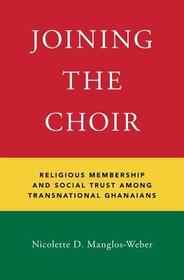
Joining the Choir
Religious Membership and Social Trust Among Transnational Ghanaians
-
10% KEDVEZMÉNY?
- A kedvezmény csak az 'Értesítés a kedvenc témákról' hírlevelünk címzettjeinek rendeléseire érvényes.
- Kiadói listaár GBP 93.00
-
44 430 Ft (42 315 Ft + 5% áfa)
Az ár azért becsült, mert a rendelés pillanatában nem lehet pontosan tudni, hogy a beérkezéskor milyen lesz a forint árfolyama az adott termék eredeti devizájához képest. Ha a forint romlana, kissé többet, ha javulna, kissé kevesebbet kell majd fizetnie.
- Kedvezmény(ek) 10% (cc. 4 443 Ft off)
- Kedvezményes ár 39 988 Ft (38 084 Ft + 5% áfa)
Iratkozzon fel most és részesüljön kedvezőbb árainkból!
Feliratkozom
44 430 Ft

Beszerezhetőség
Becsült beszerzési idő: A Prosperónál jelenleg nincsen raktáron, de a kiadónál igen. Beszerzés kb. 3-5 hét..
A Prosperónál jelenleg nincsen raktáron.
Why don't you give exact delivery time?
A beszerzés időigényét az eddigi tapasztalatokra alapozva adjuk meg. Azért becsült, mert a terméket külföldről hozzuk be, így a kiadó kiszolgálásának pillanatnyi gyorsaságától is függ. A megadottnál gyorsabb és lassabb szállítás is elképzelhető, de mindent megteszünk, hogy Ön a lehető leghamarabb jusson hozzá a termékhez.
A termék adatai:
- Kiadó OUP USA
- Megjelenés dátuma 2018. április 26.
- ISBN 9780190841041
- Kötéstípus Keménykötés
- Terjedelem240 oldal
- Méret 160x236x25 mm
- Súly 499 g
- Nyelv angol 0
Kategóriák
Rövid leírás:
In this book, Nicolette D. Manglos-Weber takes a deeply personal look at the lives of a few central characters in Accra, Ghana and Chicago, Illinois, examining what religious membership means for them as Christians, transmational Ghanaians, and aspirational migrants. Their stories highlight the continuing role of religion as a portable basis of trust in the modern world, where more people live between nations.
TöbbHosszú leírás:
Immigration and race are contentious issues in North America. As a result, immigrants from Ghana and other countries of West Africa confront major challenges in the social context of the United States, even as their experiences and accomplishments confound stereotypes. Religious congregations have often helped immigrants navigate the tricky waters of integration in the past; yet how do these particular black immigrants approach organized religion in light of their identities and aspirations? What are they looking for in religious membership, and how do they find it?
In Joining the Choir, Nicolette D. Manglos-Weber takes a deeply personal look at the lives of a few central characters in Accra, Ghana and Chicago, Illinois, examining what religious membership means for them as Christians, transnational Ghanaians, and aspirational migrants. She sheds light on their search for people they can trust and their desires to transcend divisions of race, ethnicity, and nationality in the context of Evangelical Christianity. Her characters are complex, motivated, and adaptable people for whom religious membership answers some questions of integration and raises others.
The stories of these migrants show how racial divides are subtly perpetuated within congregations in spite of hopes for religious-based assimilation. Yet they also reveal the potential of religious-based personal trust to bridge those divides, as an imaginative and symbolic leap of faith with the unknown stranger. Finally, their stories highlight the continuing role of religion as a portable basis of trust in the modern world, where more and more people live between nations.
Joining the Choir is a well-written and well-structured book that greatly informs us about the role that religious memberships play in the lives of diverse African migrants in coping with the many challenges that they face in coming to the United States.Joining the Choir will naturally be of particular interest to scholars with an interest in the integration of African migrants in United States, but certainly also to scholars with a general interest in questions of immigration and integration.
Tartalomjegyzék:
Central Characters
1. Introduction
2. The Setting: Migration, Social Trust, and Religion
3. The Sources of Risk: Inequality, the Racial Order, and Group Competition
4. The Draw of Religion: Accessibility, Portability and Promise
5. The Culture of Connection: Practices and Principles
6. The Shape of Identity: Visions, Revisions and Negotiations
7. The Nature of Faith: Between Believing and Belonging
8. Conclusion: Religious Bases of Trust and Integration
Methodological Appendix
Bibliography
Notes

