

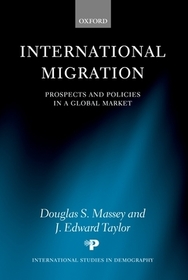
International Migration
Prospects and Policies in a Global Market
Sorozatcím: International Studies in Demography;
-
10% KEDVEZMÉNY?
- A kedvezmény csak az 'Értesítés a kedvenc témákról' hírlevelünk címzettjeinek rendeléseire érvényes.
- Kiadói listaár GBP 267.50
-
127 798 Ft (121 712 Ft + 5% áfa)
Az ár azért becsült, mert a rendelés pillanatában nem lehet pontosan tudni, hogy a beérkezéskor milyen lesz a forint árfolyama az adott termék eredeti devizájához képest. Ha a forint romlana, kissé többet, ha javulna, kissé kevesebbet kell majd fizetnie.
- Kedvezmény(ek) 10% (cc. 12 780 Ft off)
- Kedvezményes ár 115 018 Ft (109 541 Ft + 5% áfa)
Iratkozzon fel most és részesüljön kedvezőbb árainkból!
Feliratkozom
127 798 Ft

Beszerezhetőség
Megrendelésre a kiadó utánnyomja a könyvet. Rendelhető, de a szokásosnál kicsit lassabban érkezik meg.
Why don't you give exact delivery time?
A beszerzés időigényét az eddigi tapasztalatokra alapozva adjuk meg. Azért becsült, mert a terméket külföldről hozzuk be, így a kiadó kiszolgálásának pillanatnyi gyorsaságától is függ. A megadottnál gyorsabb és lassabb szállítás is elképzelhető, de mindent megteszünk, hogy Ön a lehető leghamarabb jusson hozzá a termékhez.
A termék adatai:
- Kiadó OUP Oxford
- Megjelenés dátuma 2004. március 25.
- ISBN 9780199269006
- Kötéstípus Keménykötés
- Terjedelem408 oldal
- Méret 242x163x27 mm
- Súly 733 g
- Nyelv angol
- Illusztrációk Numerous figures and tables 0
Kategóriák
Rövid leírás:
International Migration: Prospects and Policies offers a comprehensive, up-to-date survey of global patterns of international migration and the policies employed to manage the flows. It shows that international migration is not rooted in poverty or rapid population growth, but in the expansion and consolidation of global markets. The insertion of non-market societies into global networks of trade unleashes structural transformations that displace people to create
migrants. Globalization also creates infrastructures of transportation, communication, and social networks to put developed societies within reach. In the latter, aging populations and segmenting markets create a persistent demand for immigrant workers. All these trends are likely to intensify in the coming years
to make immigration policy a key political issue in the twenty-first century.
Hosszú leírás:
International Migration: Prospects and Policies offers a comprehensive, up-to-date survey of global patterns of international migration and the policies employed to manage the flows. It shows that international migration is not rooted in poverty or rapid population growth, but in the expansion and consolidation of global markets. As nations are structurally transformed by their incorporation into global markets, people are displaced from traditional livelihoods and become international migrants. In seeking to work abroad, they do not necessarily move to the closest or richest destination, but to places already connected to their countries of origin socially, economically, and politically. When they move, migrants rely heavily on social networks created by earlier waves of immigrants, and, in recent years, professional migration brokers have become increasingly common.
Developing countries generally benefit from international migration because migrant savings and remittances provide foreign earnings to finance balance of payments deficits and make productive investments. Some developing nations have gone so far as to establish programs or ministries dedicated to the export of workers. Developed nations, in contrast, focus more on the social and economic costs of immigrants and seek to reduce their numbers, regulate their characteristics, and limit their access to social services. Over time, receiving nations have gravitated toward a similar set of restrictive policies, yielding undocumented migration as a worldwide phenomenon.
Globalization also creates infrastructures of transportation, communication, and social networks to put developed societies within reach. In the latter, ageing populations and segmenting markets create a persistent demand for immigrant workers. All these trends are likely to intensify in the coming years to make immigration policy a key political issue in the twenty-first century.
Tartalomjegyzék:
Introduction
Part I: Prospects
Population Growth and International Migration
The Effects of Political and Economic Transition on International Migration in Central and Eastern Europe
Trends in International Migration in and from Africa
International Migration in the Asia-Pacific Region: Emerging Trends and Issues
Immigration and the Labor Market in Metropolitan Buenos Aires
Mexican Migration to the United States: The Effect of NAFTA
Immigrants in the U.S. Economy
Part II: Policies in Sending Nations
Remittances, Savings, and Development in Migrant-Sending Areas
Labor Export Strategies in Asia
The Role of Recruiters in Labor Migration
Return Migration in the Philippines: Issues and Policies
International Migration, Identity, and Development in Oceania: A Synthesis of Ideas
Part III: Policies in Receiving Nations
Policies and Immigrant Skills: Evidence from the U.S. Immigrant Cohorts of 1977, 1982, and 1994
Admissions Policies in Europe
The New European Asylum Regime
Immigrants and the Welfare State in Europe
The Legacy of Welfare Reform for U.S. Immigrants
Controlling International Migration through Enforcement: The Case of the United States
Part IV: Prospects and Policies Reconsidered
Back to the Future: Immigration Research, Immigration Policy, and Globalization in the Twenty-First Century

