

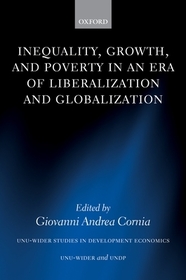
Inequality, Growth, and Poverty in an Era of Liberalization and Globalization
Sorozatcím: WIDER Studies in Development Economics;
-
10% KEDVEZMÉNY?
- A kedvezmény csak az 'Értesítés a kedvenc témákról' hírlevelünk címzettjeinek rendeléseire érvényes.
- Kiadói listaár GBP 140.00
-
63 210 Ft (60 200 Ft + 5% áfa)
Az ár azért becsült, mert a rendelés pillanatában nem lehet pontosan tudni, hogy a beérkezéskor milyen lesz a forint árfolyama az adott termék eredeti devizájához képest. Ha a forint romlana, kissé többet, ha javulna, kissé kevesebbet kell majd fizetnie.
- Kedvezmény(ek) 10% (kb. 6 321 Ft)
- Kedvezményes ár 56 889 Ft (54 180 Ft + 5% áfa)
Iratkozzon fel most és részesüljön kedvezőbb árainkból!
Feliratkozom
63 210 Ft

Beszerezhetőség
Megrendelésre a kiadó utánnyomja a könyvet. Rendelhető, de a szokásosnál kicsit lassabban érkezik meg.
Why don't you give exact delivery time?
A beszerzés időigényét az eddigi tapasztalatokra alapozva adjuk meg. Azért becsült, mert a terméket külföldről hozzuk be, így a kiadó kiszolgálásának pillanatnyi gyorsaságától is függ. A megadottnál gyorsabb és lassabb szállítás is elképzelhető, de mindent megteszünk, hogy Ön a lehető leghamarabb jusson hozzá a termékhez.
A termék adatai:
- Kiadás sorszáma New ed
- Kiadó OUP Oxford
- Megjelenés dátuma 2005. június 16.
- ISBN 9780199284108
- Kötéstípus Puhakötés
- Terjedelem464 oldal
- Méret 234x158x25 mm
- Súly 716 g
- Nyelv angol
- Illusztrációk numerous figures and tables 0
Kategóriák
Rövid leírás:
Based on an extensive review of relevant literature and an econometric analysis of inequality indexes, this volume provides the first systematic analysis of the changes in within-country income inequality over the last twenty years. In particular, it shows that inequality worsened in seventy per cent of the 73 developed, developing, and transitional countries analysed, and evaluates possible causes for this widespread rise in income inequality. The book goes on to offer the first empirical assessment of the relation between policies towards liberalization and globalization and income inequality.
TöbbHosszú leírás:
Within-country income inequality has risen since the early 1980s in most of the OECD, all transitional, and many developing countries. More recently, inequality has risen also in India and nations affected by the Asian crisis. Altogether, over the last twenty years, inequality worsened in 70 per cent of the 73 countries analysed in this volume, with the Gini index rising by over five points in half of them. In several cases, the Gini index follows a U-shaped pattern, with the turn-around point located between the late 1970s and early 1990s. Where the shift towards liberalization and globalization was concluded, the right arm of the U stabilized at the 'steady state level of inequality' typical of the new policy regime, as observed in the UK after 1990.
Mainstream theory focusing on rises in wage differentials by skill caused by either North-South trade, migration, or technological change poorly explains the recent rise in income inequality. Likewise, while the traditional causes of income polarization-high land concentration, unequal access to education, the urban bias, the 'curse of natural resources'-still account for much of cross-country variation in income inequality, they cannot explain its recent rise.
This volume suggests that the recent rise in income inequality was caused to a considerable extent by a policy-driven worsening in factorial income distribution, wage spread and spatial inequality. In this regard, the volume discusses the distributive impact of reforms in trade and financial liberalization, taxation, public expenditure, safety nets, and labour markets. The volume thus represents one of the first attempts to analyse systematically the relation between policy changes inspired by liberalization and globalization and income inequality. It suggests that capital account liberalization appears to have had-on average-the strongest disequalizing effect, followed by domestic financial liberalization, labour market deregulation, and tax reform. Trade liberalization had unclear effects, while public expenditure reform often had positive effects.
'..essential reading for anyone concerned with poverty reduction and the impact of current policy reforms'
Tartalomjegyzék:
PART I: INCOME DISTRIBUTION TRENDS,THEORIES AND POLICIES
Inequality, Growth and Poverty: An Overview of Changes over the Last Two Decades
Income Distribution Changes and Their Impact in the Post-World War II period
PART II: TRADITIONAL CAUSES OF INEQUALITY: STILL RELEVANT FOR EXPLAINING ITS RISE IN THE 1980s-90s?
Land Ownership Inequality and the Income Distribution Consequences of Economic Growth
Does Educational Achievement Help Explain Income Inequality?
Rural and Urban Income and Poverty: Does Convergence Between Sectors Offset Divergence within Them?
PART III. RECENT FACTORS INFLUENCING THE DISTRIBUTION OF INCOME
Globalization, Technology and Income Inequality: A Critical Analysis
External Liberalization, Economic Performance and Distribution in Latin America and Elsewhere
Labour Market Institutions and Income Inequality: What are the New Insights after the Washington Consensus?
Increased Income Inequality in OECD Countries and the Redistributive Impact of the Government Budget
Income Distribution and Tax and Government Social Spending Policies in Developing Countries
The Impact of Adjustment-Related Social Funds on Income Distribution and Poverty
PART IV. COUNTRY CASE STUDIES
Reducing Poverty and Inequality in India: Has Liberalization Helped?
Factor Shares and Resource Booms: Accounting for the Evolution of Venezuelan Inequality
The Impact of Financial Liberalization and the Rise of Financial Rents on Income Inequality: The Case of Turkey
The Changing Nature of Inequality in South Africa
Growth, Structural Change and Inequality: The Experience of Thailand
Index

