

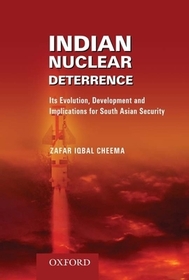
Indian Nuclear Deterrence
Its Evolution, Development and Implications for South Asian Security
-
10% KEDVEZMÉNY?
- A kedvezmény csak az 'Értesítés a kedvenc témákról' hírlevelünk címzettjeinek rendeléseire érvényes.
- Kiadói listaár GBP 22.50
-
10 158 Ft (9 675 Ft + 5% áfa)
Az ár azért becsült, mert a rendelés pillanatában nem lehet pontosan tudni, hogy a beérkezéskor milyen lesz a forint árfolyama az adott termék eredeti devizájához képest. Ha a forint romlana, kissé többet, ha javulna, kissé kevesebbet kell majd fizetnie.
- Kedvezmény(ek) 10% (cc. 1 016 Ft off)
- Kedvezményes ár 9 143 Ft (8 708 Ft + 5% áfa)
Iratkozzon fel most és részesüljön kedvezőbb árainkból!
Feliratkozom
10 158 Ft

Beszerezhetőség
A kiadónál véglegesen elfogyott, nem rendelhető. Érdemes újra keresni a címmel, hátha van újabb kiadás.
Why don't you give exact delivery time?
A beszerzés időigényét az eddigi tapasztalatokra alapozva adjuk meg. Azért becsült, mert a terméket külföldről hozzuk be, így a kiadó kiszolgálásának pillanatnyi gyorsaságától is függ. A megadottnál gyorsabb és lassabb szállítás is elképzelhető, de mindent megteszünk, hogy Ön a lehető leghamarabb jusson hozzá a termékhez.
A termék adatai:
- Kiadó OUP Pakistan
- Megjelenés dátuma 2010. július 29.
- ISBN 9780195979039
- Kötéstípus Keménykötés
- Terjedelem500 oldal
- Méret 246x165x39 mm
- Súly 1144 g
- Nyelv angol 0
Kategóriák
Hosszú leírás:
The significance of this study is that it establishes the fallacy of conventional perspectives on Indian nuclear deterrence-that the Indian nuclear programme entailed 'exclusively peaceful uses' during the Nehru era and the development of weapons capability was initiated by the government of Lal Bahadur Shastri after the first Chinese nuclear explosion in 1964. On the contrary, it provides incontrovertible documentary evidence that Dr Homi J. Bhabha formulated with
Nehru's approval a nuclear weapons development strategy within the structural framework of the Indian civilian nuclear programme. Nehru was interested in a nuclear weapons capability for a 'deterrent in extremis'.
The central premise of the study is that BJP government's decision to carry out the May 1998 nuclear tests was not an original one, but a step prefigured in a strategic continuum whose genesis dates back to the late 1950s. It suggests that the declaration of Indian nuclear deterrence after the May 1998 nuclear tests, the weaponization of Indian nuclear capability and the pronouncement of the Draft Nuclear Doctrine (DND) were not separate from earlier policies, but instead were part of that
strategic continuum. The study analyses the dynamics of Indian nuclear deterrence, Indian nuclear doctrine and their implications for South Asian security.
It is the first time that mostly primary archival, and documentary research material from diverse sources has been explored to write a book on this topic. It is more comprehensive than any other book on this subject in terms both of its timeframe (1947 until now) and of the issues covered-the evolution, development, dynamics and implications of Indian nuclear deterrence for South Asian Security. It is also the first book on the topic written from a Pakistani perspective.
Tartalomjegyzék:
Preface
Acknowledgement
Abbreviations
Introduction
: The Nehru Era: Creating a Nuclear Weapons Option
Indian Nuclear Diplomacy: Protecting The Weapons Option
From Nuclear Option to a Weapons Capability (1964-1977)
Pakistan's Nuclear Policy and Its Input Into the Indian Nuclear Decision-Making
: Indian Nuclear Policy: 1977-1998: Expanding the Weapons Capability
Dynamics of The Indian Nuclear (Deterrent) Capability: An Evaluation
The Indian Nuclear Doctrine: An Analysis
Development of Nuclear Deterrence in South Asia
Indian Nuclear Deterrence and Strategic Stability in South Asia
: Summary
Appendices
Bibliography
Index

