

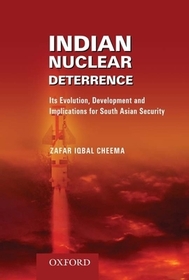
Indian Nuclear Deterrence
Its Evolution, Development and Implications for South Asian Security
- Publisher's listprice GBP 22.50
-
10 158 Ft (9 675 Ft + 5% VAT)
The price is estimated because at the time of ordering we do not know what conversion rates will apply to HUF / product currency when the book arrives. In case HUF is weaker, the price increases slightly, in case HUF is stronger, the price goes lower slightly.
- Discount 10% (cc. 1 016 Ft off)
- Discounted price 9 143 Ft (8 708 Ft + 5% VAT)
Subcribe now and take benefit of a favourable price.
Subscribe
10 158 Ft

Availability
Out of print
Why don't you give exact delivery time?
Delivery time is estimated on our previous experiences. We give estimations only, because we order from outside Hungary, and the delivery time mainly depends on how quickly the publisher supplies the book. Faster or slower deliveries both happen, but we do our best to supply as quickly as possible.
Product details:
- Publisher OUP Pakistan
- Date of Publication 29 July 2010
- ISBN 9780195979039
- Binding Hardback
- No. of pages500 pages
- Size 246x165x39 mm
- Weight 1144 g
- Language English 0
Categories
Long description:
The significance of this study is that it establishes the fallacy of conventional perspectives on Indian nuclear deterrence-that the Indian nuclear programme entailed 'exclusively peaceful uses' during the Nehru era and the development of weapons capability was initiated by the government of Lal Bahadur Shastri after the first Chinese nuclear explosion in 1964. On the contrary, it provides incontrovertible documentary evidence that Dr Homi J. Bhabha formulated with
Nehru's approval a nuclear weapons development strategy within the structural framework of the Indian civilian nuclear programme. Nehru was interested in a nuclear weapons capability for a 'deterrent in extremis'.
The central premise of the study is that BJP government's decision to carry out the May 1998 nuclear tests was not an original one, but a step prefigured in a strategic continuum whose genesis dates back to the late 1950s. It suggests that the declaration of Indian nuclear deterrence after the May 1998 nuclear tests, the weaponization of Indian nuclear capability and the pronouncement of the Draft Nuclear Doctrine (DND) were not separate from earlier policies, but instead were part of that
strategic continuum. The study analyses the dynamics of Indian nuclear deterrence, Indian nuclear doctrine and their implications for South Asian security.
It is the first time that mostly primary archival, and documentary research material from diverse sources has been explored to write a book on this topic. It is more comprehensive than any other book on this subject in terms both of its timeframe (1947 until now) and of the issues covered-the evolution, development, dynamics and implications of Indian nuclear deterrence for South Asian Security. It is also the first book on the topic written from a Pakistani perspective.
Table of Contents:
Preface
Acknowledgement
Abbreviations
Introduction
: The Nehru Era: Creating a Nuclear Weapons Option
Indian Nuclear Diplomacy: Protecting The Weapons Option
From Nuclear Option to a Weapons Capability (1964-1977)
Pakistan's Nuclear Policy and Its Input Into the Indian Nuclear Decision-Making
: Indian Nuclear Policy: 1977-1998: Expanding the Weapons Capability
Dynamics of The Indian Nuclear (Deterrent) Capability: An Evaluation
The Indian Nuclear Doctrine: An Analysis
Development of Nuclear Deterrence in South Asia
Indian Nuclear Deterrence and Strategic Stability in South Asia
: Summary
Appendices
Bibliography
Index

