

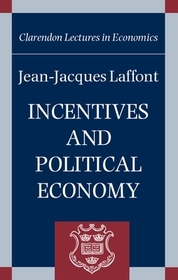
Incentives and Political Economy
Sorozatcím: Clarendon Lectures in Economics;
-
10% KEDVEZMÉNY?
- A kedvezmény csak az 'Értesítés a kedvenc témákról' hírlevelünk címzettjeinek rendeléseire érvényes.
- Kiadói listaár GBP 70.00
-
31 605 Ft (30 100 Ft + 5% áfa)
Az ár azért becsült, mert a rendelés pillanatában nem lehet pontosan tudni, hogy a beérkezéskor milyen lesz a forint árfolyama az adott termék eredeti devizájához képest. Ha a forint romlana, kissé többet, ha javulna, kissé kevesebbet kell majd fizetnie.
- Kedvezmény(ek) 10% (kb. 3 161 Ft)
- Kedvezményes ár 28 445 Ft (27 090 Ft + 5% áfa)
Iratkozzon fel most és részesüljön kedvezőbb árainkból!
Feliratkozom
31 605 Ft

Beszerezhetőség
Megrendelésre a kiadó utánnyomja a könyvet. Rendelhető, de a szokásosnál kicsit lassabban érkezik meg.
Why don't you give exact delivery time?
A beszerzés időigényét az eddigi tapasztalatokra alapozva adjuk meg. Azért becsült, mert a terméket külföldről hozzuk be, így a kiadó kiszolgálásának pillanatnyi gyorsaságától is függ. A megadottnál gyorsabb és lassabb szállítás is elképzelhető, de mindent megteszünk, hogy Ön a lehető leghamarabb jusson hozzá a termékhez.
A termék adatai:
- Kiadó OUP Oxford
- Megjelenés dátuma 2001. október 18.
- ISBN 9780199248681
- Kötéstípus Puhakötés
- Terjedelem272 oldal
- Méret 218x139x15 mm
- Súly 388 g
- Nyelv angol
- Illusztrációk numerous figures 0
Kategóriák
Rövid leírás:
Incentives and Political Economy constructs a normative approach to constitutional design using recent developments in contract theory. It treats political economy as the study of the incentive problems created by the delegation of economic policy to self-interested politicians. Politicians are treated successively as informed supervisors or residual decision-makers. The optimal constitutional responses to the activities of interest groups are characterized in various circumstances, as well as the optimal trade-off between flexibility of decision-making and discretion to pursue personal agendas when the incompleteness of the constitutional contract is recognized.
TöbbHosszú leírás:
Mainstream economics has only recently recognized the need to incorporate political constraints into economic analysis intended for policy advisors. "Incentives and Political Economy" uses recent advances in contract theory to build a normative approach to constitutional design in economic environments. It is written by one of Europe's leading theorists.
The first part of the book remains in the tradition of benevolent constitutional design with complete contracting. It treats politicians as informed supervisors and studies how the Constitution should control them, in particular to avoid capture by interest groups. Incentive theories for the separation of powers or systems of checks and balances are developed.
The second part of the book recognizes the incompleteness of the constitutional contract which leaves a lot of discretion to the politicians selected by the electoral process. Asymmetric information associates information rents with economic policies and the political game becomes a game of costly redistribution of those rents. Professor Laffont investigates the trade-offs between an inflexible constitution which leaves little discretion to politicians but sacrifices ex post efficiency and a constitution weighted towards ex post efficiency but also giving considerable discretion to politicians to pursue private agendas.
The final part of the book reconsiders the modeling of collusion given asymmetric information. It proposes a new approach to characterizing incentives constraints for group behaviour when asymmetric information is non-verifiable. This provides a methodology to characterize the optimal constitutional response to activities of interest groups and to study the design of any institutions in which group behavior is important.
Review from previous edition deals with the subject in a refreshing piecemeal approach that will allow researchers to embed elements of the theory into their favourite political economy models.
Tartalomjegyzék:
Chapter 1: Introduction
Part I: Politicians as Informed Supervisors
Chapter 2: The Complete Contract Approach to Constitutional Design
Chapter 3: An Incentive Theory of the Separation of Powers
Chapter 4: Checks and Balances
Part II: Flexibility versus Discretion in Constitutional Design
Chapter 5: Political Economy and Industrial Policy
Chapter 6: Political Economy and the Marginal Cost Pricing Controversy
Chapter 7: Toward a Political Theory of the Emergence of Environmental Incentive Regulation
Part III: Coalition Formation and Constitutional Design
Chapter 8: Optimal Constitutional Responses to Coalition Formation
Chapter 9: Collusion and Decentralization
Chapter 10: Concluding Remarks

