

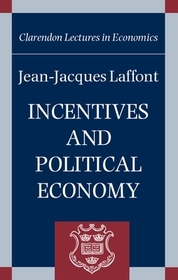
Incentives and Political Economy
Series: Clarendon Lectures in Economics;
- Publisher's listprice GBP 70.00
-
31 605 Ft (30 100 Ft + 5% VAT)
The price is estimated because at the time of ordering we do not know what conversion rates will apply to HUF / product currency when the book arrives. In case HUF is weaker, the price increases slightly, in case HUF is stronger, the price goes lower slightly.
- Discount 10% (cc. 3 161 Ft off)
- Discounted price 28 445 Ft (27 090 Ft + 5% VAT)
Subcribe now and take benefit of a favourable price.
Subscribe
31 605 Ft

Availability
printed on demand
Why don't you give exact delivery time?
Delivery time is estimated on our previous experiences. We give estimations only, because we order from outside Hungary, and the delivery time mainly depends on how quickly the publisher supplies the book. Faster or slower deliveries both happen, but we do our best to supply as quickly as possible.
Product details:
- Publisher OUP Oxford
- Date of Publication 18 October 2001
- ISBN 9780199248681
- Binding Paperback
- No. of pages272 pages
- Size 218x139x15 mm
- Weight 388 g
- Language English
- Illustrations numerous figures 0
Categories
Short description:
Incentives and Political Economy constructs a normative approach to constitutional design using recent developments in contract theory. It treats political economy as the study of the incentive problems created by the delegation of economic policy to self-interested politicians. Politicians are treated successively as informed supervisors or residual decision-makers. The optimal constitutional responses to the activities of interest groups are characterized in various circumstances, as well as the optimal trade-off between flexibility of decision-making and discretion to pursue personal agendas when the incompleteness of the constitutional contract is recognized.
MoreLong description:
Mainstream economics has only recently recognized the need to incorporate political constraints into economic analysis intended for policy advisors. "Incentives and Political Economy" uses recent advances in contract theory to build a normative approach to constitutional design in economic environments. It is written by one of Europe's leading theorists.
The first part of the book remains in the tradition of benevolent constitutional design with complete contracting. It treats politicians as informed supervisors and studies how the Constitution should control them, in particular to avoid capture by interest groups. Incentive theories for the separation of powers or systems of checks and balances are developed.
The second part of the book recognizes the incompleteness of the constitutional contract which leaves a lot of discretion to the politicians selected by the electoral process. Asymmetric information associates information rents with economic policies and the political game becomes a game of costly redistribution of those rents. Professor Laffont investigates the trade-offs between an inflexible constitution which leaves little discretion to politicians but sacrifices ex post efficiency and a constitution weighted towards ex post efficiency but also giving considerable discretion to politicians to pursue private agendas.
The final part of the book reconsiders the modeling of collusion given asymmetric information. It proposes a new approach to characterizing incentives constraints for group behaviour when asymmetric information is non-verifiable. This provides a methodology to characterize the optimal constitutional response to activities of interest groups and to study the design of any institutions in which group behavior is important.
Review from previous edition deals with the subject in a refreshing piecemeal approach that will allow researchers to embed elements of the theory into their favourite political economy models.
Table of Contents:
Chapter 1: Introduction
Part I: Politicians as Informed Supervisors
Chapter 2: The Complete Contract Approach to Constitutional Design
Chapter 3: An Incentive Theory of the Separation of Powers
Chapter 4: Checks and Balances
Part II: Flexibility versus Discretion in Constitutional Design
Chapter 5: Political Economy and Industrial Policy
Chapter 6: Political Economy and the Marginal Cost Pricing Controversy
Chapter 7: Toward a Political Theory of the Emergence of Environmental Incentive Regulation
Part III: Coalition Formation and Constitutional Design
Chapter 8: Optimal Constitutional Responses to Coalition Formation
Chapter 9: Collusion and Decentralization
Chapter 10: Concluding Remarks

