

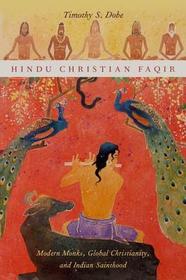
Hindu Christian Faqir
Modern Monks, Global Christianity, and Indian Sainthood
Sorozatcím: AAR Religion, Culture, and History;
-
10% KEDVEZMÉNY?
- A kedvezmény csak az 'Értesítés a kedvenc témákról' hírlevelünk címzettjeinek rendeléseire érvényes.
- Kiadói listaár GBP 125.00
-
56 437 Ft (53 750 Ft + 5% áfa)
Az ár azért becsült, mert a rendelés pillanatában nem lehet pontosan tudni, hogy a beérkezéskor milyen lesz a forint árfolyama az adott termék eredeti devizájához képest. Ha a forint romlana, kissé többet, ha javulna, kissé kevesebbet kell majd fizetnie.
- Kedvezmény(ek) 10% (cc. 5 644 Ft off)
- Kedvezményes ár 50 794 Ft (48 375 Ft + 5% áfa)
Iratkozzon fel most és részesüljön kedvezőbb árainkból!
Feliratkozom
56 437 Ft

Beszerezhetőség
Megrendelésre a kiadó utánnyomja a könyvet. Rendelhető, de a szokásosnál kicsit lassabban érkezik meg.
Why don't you give exact delivery time?
A beszerzés időigényét az eddigi tapasztalatokra alapozva adjuk meg. Azért becsült, mert a terméket külföldről hozzuk be, így a kiadó kiszolgálásának pillanatnyi gyorsaságától is függ. A megadottnál gyorsabb és lassabb szállítás is elképzelhető, de mindent megteszünk, hogy Ön a lehető leghamarabb jusson hozzá a termékhez.
A termék adatai:
- Kiadó OUP USA
- Megjelenés dátuma 2015. október 29.
- ISBN 9780199987696
- Kötéstípus Keménykötés
- Terjedelem384 oldal
- Méret 157x236x27 mm
- Súly 771 g
- Nyelv angol 0
Kategóriák
Rövid leírás:
Hindu Christian Faqir compares two colonial Indian holy men: the Hindu Rama Tirtha and the Christian Sundar Singh.
TöbbHosszú leírás:
Hindu Christian Faqir compares two colonial Indian saints from Punjab, the neo-Vedantin Hindu Rama Tirtha (1873-1906) and the Christian convert Sundar Singh (1889-1929). Timothy S. Dobe shows that varied asceticisms, personal exemplary models, and material religion exuded their ambivalent and powerful public presence in Protestant metropolitan centers as much as in colonial peripheries. Challenging ideas of the invention of modern Hinduism, the transparent translation of Christianity, and the construction of saints by devotees, this book focuses on the long-standing, shared religious idioms on which these two men creatively drew to appeal to transnational audiences and to pursue religious perfection.
Following both men's usage of Urdu, the book adopts the word "faqir" to examine the vernacular and performative dimensions of Indian holy man traditions, thereby calling special attention to missionary and Orientalist anti-ascetic accounts of the "fukeer" indigenous Islamic traditions and this-worldly religion. Exploring Rama Tirtha and Sundar Singh's global tours in Europe and America, self-conscious sartorial styles, and intimate autobiographical writings, Dobe demonstrates that the vernacular holy man traditions of Punjab provided resources that both men drew on to construct their forms of modern monkhood. The rise of heroic, anti-colonial sannyasis or sadhus of modern Hinduism like Swami Vivekananda is thus repositioned in relation to global Christianity, Sufi, bhakti, and Sikh regional practices, religious boundary-crossing, contestation and conversion.
A comparative and contextualized story of two Punjabi holy men's particular performance of sainthood, Hindu Christian Faqir reveals much about the broad, interactional history of religious modernities.
The tools -- theoretical, linguistic, and cultural -- Dobe employs in making his case are truly remarkable, and the copious endnotes by themselves may be worth the price of the book. It is a work of profound ascesis, both in the writing and in the reading.
Tartalomjegyzék:
Acknowledgements
Note on Diacritical Marks
List of Images
Chapter 1 - Introduction: Unsettling Saints
Chapter 2 - How the Pope came to Punjab: Vernacular Beginnings, Protestant Idols and Ascetic Publics
Chapter 3 - Resurrecting the Saints: The Rise of the High Imperial Holy Man
Chapter 4 - The Saffron Skin of Rama Tirtha: Dressing for the West, the Spiritual Race and an Advaitin Autonomy
Chapter 5 - Sundar Singh and the Oriental Christ of the West
Chapter 6 - Rama Tirtha's Vernacular Vedanta: Autohagiographical Fragments of Rama's Indo-Persian Mysticism
Chapter 7 - Frail Soldiers of the Cross: Lesser Known Lives of Sundar Singh
Conclusion - Losing and Finding Religion
Bibliography
Index

