

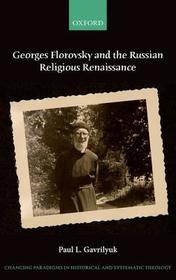
Georges Florovsky and the Russian Religious Renaissance
Sorozatcím: Changing Paradigms in Historical and Systematic Theology;
-
10% KEDVEZMÉNY?
- A kedvezmény csak az 'Értesítés a kedvenc témákról' hírlevelünk címzettjeinek rendeléseire érvényes.
- Kiadói listaár GBP 107.50
-
51 358 Ft (48 912 Ft + 5% áfa)
Az ár azért becsült, mert a rendelés pillanatában nem lehet pontosan tudni, hogy a beérkezéskor milyen lesz a forint árfolyama az adott termék eredeti devizájához képest. Ha a forint romlana, kissé többet, ha javulna, kissé kevesebbet kell majd fizetnie.
- Kedvezmény(ek) 10% (cc. 5 136 Ft off)
- Kedvezményes ár 46 222 Ft (44 021 Ft + 5% áfa)
Iratkozzon fel most és részesüljön kedvezőbb árainkból!
Feliratkozom
51 358 Ft

Beszerezhetőség
Megrendelésre a kiadó utánnyomja a könyvet. Rendelhető, de a szokásosnál kicsit lassabban érkezik meg.
Why don't you give exact delivery time?
A beszerzés időigényét az eddigi tapasztalatokra alapozva adjuk meg. Azért becsült, mert a terméket külföldről hozzuk be, így a kiadó kiszolgálásának pillanatnyi gyorsaságától is függ. A megadottnál gyorsabb és lassabb szállítás is elképzelhető, de mindent megteszünk, hogy Ön a lehető leghamarabb jusson hozzá a termékhez.
A termék adatai:
- Kiadó OUP Oxford
- Megjelenés dátuma 2013. december 19.
- ISBN 9780198701583
- Kötéstípus Keménykötés
- Terjedelem314 oldal
- Méret 240x162x27 mm
- Súly 638 g
- Nyelv angol 0
Kategóriák
Rövid leírás:
This study offers a new interpretation of twentieth-century Russian Orthodox theology by engaging the work of Georges Florovsky (1893-1979), especially his program of a 'return to the Church Fathers'.
TöbbHosszú leírás:
Georges Florovsky is the mastermind of a 'return to the Church Fathers' in twentieth-century Orthodox theology. His theological vision-the neopatristic synthesis-became the main paradigm of Orthodox theology and the golden standard of Eastern Orthodox identity in the West. Focusing on Florovsky's European period (1920-1948), this study analyses how Florovsky's evolving interpretation of Russian religious thought, particularly Vladimir Solovyov and Sergius Bulgakov, informed his approach to patristic sources. Paul Gavrilyuk offers a new reading of Florovsky's neopatristic theology, by closely considering its ontological, epistemological and ecclesiological foundations.
It is common to contrast Florovsky's neopatristic theology with the 'modernist' religious philosophies of Pavel Florensky, Sergius Bulgakov, and other representatives of the Russian Religious Renaissance. Gavrilyuk argues that the standard narrative of twentieth-century Orthodox theology, based on this polarization, must be reconsidered. The author demonstrates Florovsky's critical appropriation of the main themes of the Russian Religious Renaissance, including theological antinomies, the meaning of history, and the nature of personhood. The distinctive features of Florovsky's neopatristic theology--Christological focus, 'ecclesial experience', personalism, and 'Christian Hellenism'--are best understood against the background of the main problematic of the Renaissance. Specifically, it is shown that Bulgakov's sophiology provided a polemical subtext for Florovsky's theology of creation. It is argued that the use of the patristic norm in application to modern Russian theology represents Florovsky's theological signature.
Drawing on unpublished archival material and correspondence, this study sheds new light on such aspects of Florovsky's career as his family background, his participation in the Eurasian movement, his dissertation on Alexander Herzen, his lectures on Vladimir Solovyov, and his involvement in Bulgakov's Brotherhood of St Sophia.
Excellent and lucid new book ... [a] critical appraisal of Florovsky
Tartalomjegyzék:
Preface
Introduction
The Russian Religious Renaissance before the Revolution
Early Encounters with the Renaissance
The Fathers and Children of the Renaissance in the Dispersion
The Eurasian Temptation
Philosophy of History
Reevaluation of Solovyov
Bulgakov s Antipode
The Sophiological Subtext of Neopatristic Synthesis
How The Ways of Russian Theology Came to Be Written
The Patristic Norm and the Western Pseudomorphosis of Russian Theology
The Early Reception of The Ways of Russian Theology
Christian Hellenism as Philosophia Perennis
The Ecclesiological and Epistemological Contours of the Neopatristic Synthesis
The Reception of Florovsky in Orthodox Theology
Beyond the Polarizing Narrative

