

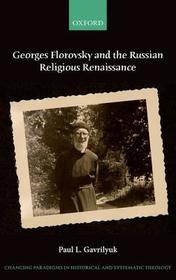
Georges Florovsky and the Russian Religious Renaissance
Series: Changing Paradigms in Historical and Systematic Theology;
- Publisher's listprice GBP 107.50
-
51 358 Ft (48 912 Ft + 5% VAT)
The price is estimated because at the time of ordering we do not know what conversion rates will apply to HUF / product currency when the book arrives. In case HUF is weaker, the price increases slightly, in case HUF is stronger, the price goes lower slightly.
- Discount 10% (cc. 5 136 Ft off)
- Discounted price 46 222 Ft (44 021 Ft + 5% VAT)
Subcribe now and take benefit of a favourable price.
Subscribe
51 358 Ft

Availability
printed on demand
Why don't you give exact delivery time?
Delivery time is estimated on our previous experiences. We give estimations only, because we order from outside Hungary, and the delivery time mainly depends on how quickly the publisher supplies the book. Faster or slower deliveries both happen, but we do our best to supply as quickly as possible.
Product details:
- Publisher OUP Oxford
- Date of Publication 19 December 2013
- ISBN 9780198701583
- Binding Hardback
- No. of pages314 pages
- Size 240x162x27 mm
- Weight 638 g
- Language English 0
Categories
Short description:
This study offers a new interpretation of twentieth-century Russian Orthodox theology by engaging the work of Georges Florovsky (1893-1979), especially his program of a 'return to the Church Fathers'.
MoreLong description:
Georges Florovsky is the mastermind of a 'return to the Church Fathers' in twentieth-century Orthodox theology. His theological vision-the neopatristic synthesis-became the main paradigm of Orthodox theology and the golden standard of Eastern Orthodox identity in the West. Focusing on Florovsky's European period (1920-1948), this study analyses how Florovsky's evolving interpretation of Russian religious thought, particularly Vladimir Solovyov and Sergius Bulgakov, informed his approach to patristic sources. Paul Gavrilyuk offers a new reading of Florovsky's neopatristic theology, by closely considering its ontological, epistemological and ecclesiological foundations.
It is common to contrast Florovsky's neopatristic theology with the 'modernist' religious philosophies of Pavel Florensky, Sergius Bulgakov, and other representatives of the Russian Religious Renaissance. Gavrilyuk argues that the standard narrative of twentieth-century Orthodox theology, based on this polarization, must be reconsidered. The author demonstrates Florovsky's critical appropriation of the main themes of the Russian Religious Renaissance, including theological antinomies, the meaning of history, and the nature of personhood. The distinctive features of Florovsky's neopatristic theology--Christological focus, 'ecclesial experience', personalism, and 'Christian Hellenism'--are best understood against the background of the main problematic of the Renaissance. Specifically, it is shown that Bulgakov's sophiology provided a polemical subtext for Florovsky's theology of creation. It is argued that the use of the patristic norm in application to modern Russian theology represents Florovsky's theological signature.
Drawing on unpublished archival material and correspondence, this study sheds new light on such aspects of Florovsky's career as his family background, his participation in the Eurasian movement, his dissertation on Alexander Herzen, his lectures on Vladimir Solovyov, and his involvement in Bulgakov's Brotherhood of St Sophia.
Excellent and lucid new book ... [a] critical appraisal of Florovsky
Table of Contents:
Preface
Introduction
The Russian Religious Renaissance before the Revolution
Early Encounters with the Renaissance
The Fathers and Children of the Renaissance in the Dispersion
The Eurasian Temptation
Philosophy of History
Reevaluation of Solovyov
Bulgakov s Antipode
The Sophiological Subtext of Neopatristic Synthesis
How The Ways of Russian Theology Came to Be Written
The Patristic Norm and the Western Pseudomorphosis of Russian Theology
The Early Reception of The Ways of Russian Theology
Christian Hellenism as Philosophia Perennis
The Ecclesiological and Epistemological Contours of the Neopatristic Synthesis
The Reception of Florovsky in Orthodox Theology
Beyond the Polarizing Narrative

